
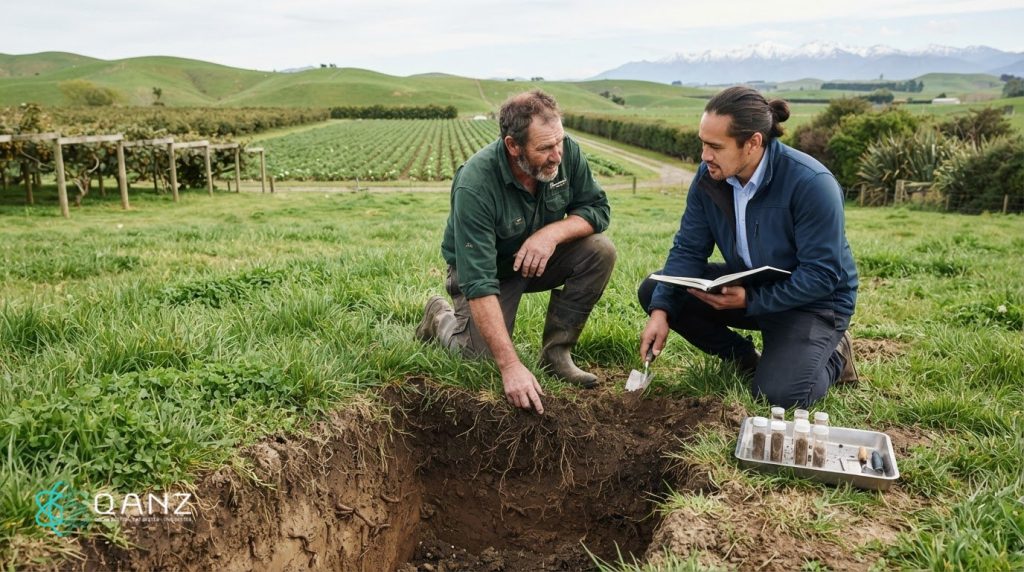
The most suitable urea alternative is one that fits the crop’s nitrogen needs and the timing of nutrient availability. Another fertiliser may supply crop-available nitrogen; an organic amendment releases nutrients differently, while a biological input isn’t automatically a nitrogen source or fertiliser substitute. Start your comparison with crop demand, relevant soil information and application timing, not the product label.
It’s understandable to look for more flexibility in a fertiliser programme, but different options don’t contribute nutrients in the same way. Growers in New Zealand also need to account for their crop, soil and local conditions. Advice or results from another country or production system may not apply directly to a particular paddock or block.
This article explains the main options to assess alongside urea and how to compare their nutrient contributions with crop needs. It also covers where soil-management practices and biological inputs fit, and what product documentation, evidence and local advice to check before changing a programme.
Key Takeaways
- Compare each urea alternative by the nitrogen it supplies and when that nitrogen may be available to the crop.
- Use crop demand and relevant soil information to judge whether an option fits your programme.
- Distinguish nitrogen fertilisers and organic nutrient sources from management practices and biological inputs.
- Check current product documentation, intended use, application rates and any certification requirements before making changes.
- Consider Quantum Organic-Total® as a microbial agricultural input within a wider crop and soil programme, not as a direct urea substitute.
What does urea do, and why look for a urea alternative?
Urea is a nitrogen fertiliser used to supply crops with nitrogen, an essential plant nutrient. It’s one source growers can consider within a nutrient programme, not a complete soil-health or crop-management solution. A urea overview explains its chemical properties and agricultural use. Whether it suits a particular crop still depends on nutrient requirements and local conditions.
What is urea used for in crop nutrition?
In practical terms, urea supplies nitrogen for crop nutrition. Nitrogen is involved in plant growth and compounds such as proteins and chlorophyll, but supplying nitrogen is only one part of managing crop nutrition. Urea doesn’t, by itself, address every soil condition or provide a complete nutrient programme.
Keep those aims separate. If you’re considering changes to soil structure, organic matter or biological activity, assess them independently from the crop-available nitrogen a fertiliser or other nutrient source contributes. A product’s broad claims or category don’t establish that it can meet a crop’s nitrogen requirement.
Why might a grower consider another option?
Urea isn’t inherently unsuitable. A grower might compare another nitrogen source because of its fit with the crop, planned application timing, current soil information or practical considerations within the wider programme. These are questions to investigate, not proof that changing products will improve results.
Before comparing options, consider:
- How much nitrogen does the crop require at its current growth stage?
- What does relevant soil information indicate, and how current and representative is it?
- When can the source be applied in relation to crop demand and the existing programme?
- Is the product’s nutrient contribution documented, and is its intended use suitable for the crop and growing system?
- What advice applies to your region and production system in New Zealand or Australia?
A urea alternative is an option assessed against a crop’s nutrient requirements, not a substitute simply because it has a different name or format. Some alternatives may supply nitrogen directly; other inputs and management practices have different roles and shouldn’t automatically be counted as nitrogen supply.
The useful comparison isn’t “urea or no urea” in isolation. Ask whether a verified option provides the intended nutrient contribution, at a suitable time, within a programme informed by crop needs, soil information and local advice. First, distinguish the different categories growers can compare.
How do nitrogen sources and soil processes affect crop nutrition?
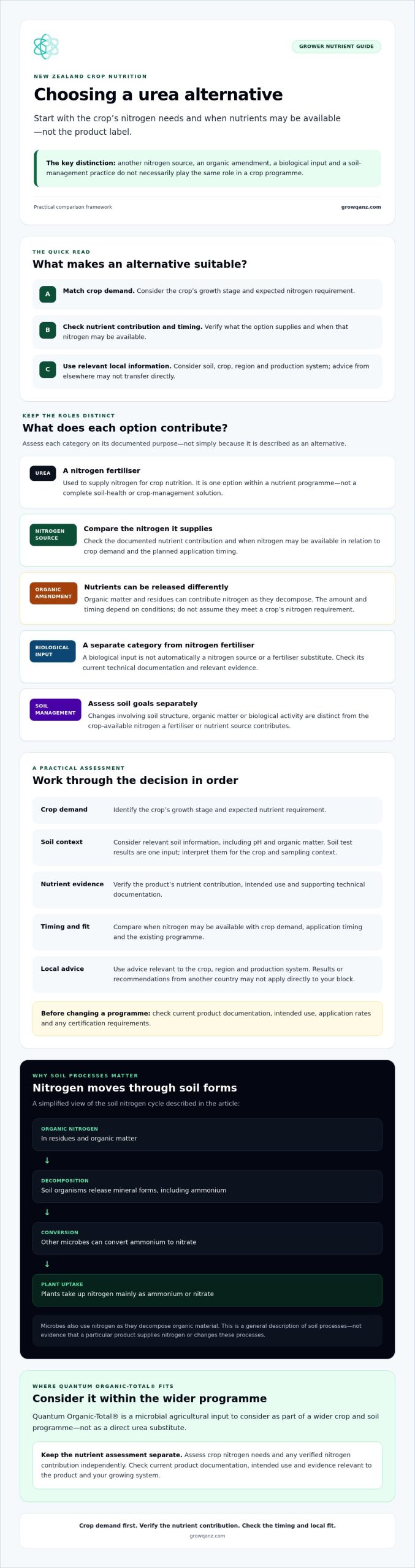
Nitrogen in soil moves through several forms and processes. Soil organisms break down organic nitrogen in residues and organic matter, releasing mineral forms such as ammonium; other microbes can convert ammonium to nitrate. Plants take up nitrogen mainly as ammonium or nitrate, while microbes also use nitrogen as they decompose organic material. This broad cycle, described in soil science texts such as Brady and Weil’s The Nature and Properties of Soils, is general science, not evidence that a particular product supplies nitrogen or changes these processes.
The suitability of a nitrogen source depends on how its documented nutrient contribution fits the crop’s growth stage, soil conditions, climate and management programme.
Which soil and crop factors should growers consider?
Crop demand changes as a plant develops, so assess its growth stage and expected nutrient requirement before comparing sources. Soil organic matter can contribute nitrogen as it decomposes, but the amount and timing depend on conditions and shouldn’t be judged by appearance alone. Moisture affects biological activity and nutrient movement; pH helps inform nutrient availability and the wider programme. These factors interact, so advice for one crop or region may not transfer directly to another.
Soil test results can help inform decisions about nutrient status and pH when interpreted for the relevant crop and sampling context. They’re one input to the assessment, not a substitute for crop-specific advice. GrowQanz supplies biological inputs, not soil testing services, so arrange suitable testing independently and discuss the results with a local agronomist or other qualified adviser in New Zealand or Australia.
How do biological inputs differ from nitrogen fertilisers?
A nitrogen fertiliser is assessed for the nitrogen it supplies. A biological input is a separate category, and its purpose and contribution need to be established from current technical documentation and evidence relevant to the product and intended use. The term “biological” alone doesn’t show that an input contains crop-available nitrogen, replaces a fertiliser or produces a particular crop response.
Keep the categories distinct when evaluating a programme. Soil-management practices may influence soil conditions over time, biological inputs may have a documented role in a crop or soil programme, and fertilisers supply nutrients according to their verified composition. Don’t count a practice or biological input as nitrogen supply unless its contribution is documented. For background on GrowQanz’s approach, see its information on biological technology.
Which urea alternatives can growers compare, and what do they provide?
Options fall into distinct categories: fertilisers that supply nitrogen, organic nutrient sources that may contribute nutrients as they break down, and management practices that influence nutrient cycling. Compare each by its documented contribution and role in the programme. A different format or product category doesn’t, by itself, mean it can do the same job as urea.
How do other nutrient sources compare with urea?
Other nitrogen fertilisers may supply nitrogen in different forms or have features intended to affect how the nutrient behaves after application. Organic nutrient sources, such as manures or composts, can contribute nutrients, but their nutrient content and release vary. Check current product documentation and evidence relevant to the material, crop and intended use. Don’t infer nutrient supply or timing from a product name or broad category.
A biological input isn’t automatically a direct nutrient-equivalent substitute for urea. Assess its documented role separately from the crop’s nitrogen requirement.
| Option category | Potential nutrient role | Evidence to check | Programme fit |
|---|---|---|---|
| Other nitrogen fertilisers | Supply nitrogen; forms and product features vary. | Verified nutrient analysis, intended use and current product documentation. | Compare with crop demand and planned timing. |
| Organic nutrient sources | May contribute nitrogen and other nutrients; content and release vary. | Analysis, source information and evidence relevant to the material. | Consider soil information, crop timing and certification requirements. |
| Management practices | May influence nutrient cycling or return nutrients to soil, but aren’t automatically a measured nitrogen input. | Evidence for the practice in the relevant crop and production system. | Assess across the rotation and don’t assume it meets every crop’s needs. |
| Biological inputs | Product-specific role; not necessarily a direct nutrient source. | Current technical documentation and evidence for the stated intended use. | Assess within the wider programme, not as a substitute for verified nutrient supply. |
For fertilisers and organic sources, compare verified nutrient analysis with crop requirements. Avoid setting rates or substitution ratios from generic guidance. Suitability depends on the crop, soil, climate, product and management plan.
Can soil-management practices replace a fertiliser decision?
Legumes in a rotation, organic matter management and returning suitable crop residues can all be considered as part of nutrient planning. Their contribution depends on the production system and conditions, so don’t assume these practices alone meet a crop’s nitrogen needs. For a proposed change, consider the whole rotation and seek crop-specific local advice.
Evidence and local sources
In New Zealand, consult current Ministry for the Environment guidance and the relevant regional council for applicable environmental requirements. Use Foundation for Arable Research resources for relevant arable-crop guidance. In Australia, check the relevant state or territory agriculture department and Grain Research and Development Corporation resources for local requirements and cropping advice. Confirm that any recommendation matches your crop, location and current programme.
How can New Zealand and Australian growers assess an alternative?
Assess a proposed change in sequence. First define the crop’s nutrient need and the intended contribution of the alternative. Then review relevant soil information, compare current product documentation and evidence, and seek advice suited to your crop and country. This helps distinguish a change in nitrogen source from a broader change to the nutrient-management programme.
What should a grower check before changing a programme?
Before adopting a urea alternative, record the crop and production system, growth stage, nutrient contribution needed, intended application timing and inputs already in the programme. Then check:
- Soil information: Are the available results relevant to the crop, block and current decision? Have them interpreted in context if needed.
- Product documentation: Does current technical information confirm the product’s intended use, nutrient analysis and application rates? Don’t infer these from a label category or general description.
- Evidence: Is the information from independent research, manufacturer trials, overseas work or a different crop? Keep those evidence types distinct and check whether they apply to your conditions.
- Programme fit: How does the proposed option fit with crop demand, timing and existing inputs? Don’t assume it supplies the same nutrient contribution as the product it may replace.
A result from another crop, country or formulation isn’t automatically transferable. A product-specific claim should be supported by evidence for that product and use. General agronomic research can inform principles, but doesn’t prove the performance of a particular input.
How should organic certification and local advice be checked?
If you farm under an organic certification programme, confirm the input’s suitability for your programme and intended use with your certifier before applying it. Don’t assume that a supplier statement, a product’s name or certification in one context settles eligibility in another. For Quantum Organic-Total®, check QANZ’s current technical information and BioGro documentation before relying on any certification claim.
Advice also needs to match the country and production system. New Zealand and Australian recommendations, product availability and certification requirements may differ, and Australian requirements can vary by state. Ask a local agronomist or relevant certifier to confirm what applies. Check overseas guidance against local conditions before using it.
For product and application information, see QANZ’s support for Quantum Organic-Total®.
Where can Quantum Organic-Total® fit in a urea-alternative assessment?
Once you’ve compared nutrient sources and identified what your crop needs, assess biological inputs separately as part of the wider crop and soil programme. Quantum Organic-Total® is a microbial agricultural input offered by QANZ for use in crop and soil programmes. This description doesn’t establish it as a direct urea replacement or confirm that it supplies an equivalent amount of crop-available nitrogen.
What is confirmed about Quantum Organic-Total®?
Quantum Organic-Total® is a microbial agricultural input offered by QANZ for use in crop and soil programmes. Product suitability, rates and certification requirements should be checked against current QANZ technical and BioGro documentation. Don’t infer its composition, mechanism, nutrient contribution, application rate or likely crop outcome beyond what current product-specific information and suitable evidence support.
Before considering it in a urea alternative assessment, review the Quantum Organic-Total® product information and confirm its current intended use, crop suitability and application guidance with QANZ. If your programme requires organic inputs, check current BioGro documentation and confirm suitability with your own certification programme. Don’t assume certification status or eligibility from a general product description.
Keep the nutrient decision separate. If your crop requires a defined nitrogen contribution, assess that need using relevant soil information, crop demand and local agronomic advice. Consider a microbial input only according to its documented role in the wider programme, not as a substitute for verified nitrogen supply.
What should growers ask QANZ before considering it?
A practical discussion can help identify what information you still need. Ask questions specific to your crop and growing system, such as:
- Is Quantum Organic-Total® intended for use with this crop and production system?
- Which current technical document sets out its intended use and application guidance?
- What evidence is available for the exact product and proposed use, and where was that evidence generated?
- What should be confirmed separately about nitrogen supply in the existing programme?
- What certification documentation should be checked in New Zealand or Australia, and with whom?
Keep the context clear when reviewing evidence: findings from another formulation, crop or country don’t automatically apply to Quantum Organic-Total® or your conditions. A measured assessment starts with transparent product information and a clear understanding of the crop’s nutrient requirements.
Discussing product suitability with QANZ can help clarify whether Quantum Organic-Total® may fit your crop, growing system and application programme. Keep nutrient decisions grounded in relevant soil information and local agronomic advice.
Make the next nutrient decision with confidence
A sound urea alternative assessment starts with the crop’s nitrogen requirement, then weighs soil information, timing and the verified nutrient contribution of each option. Fertilisers, organic nutrient sources, management practices and biological inputs have different roles. Don’t treat them as interchangeable or assume advice from another crop or country applies to your conditions.
QANZ supplies Quantum agricultural biological products to growers in New Zealand and Australia. Quantum Organic-Total® is a microbial agricultural input offered for use in crop and soil programmes, but this description doesn’t establish it as a direct urea replacement. Check current technical and certification documentation, and consider it only within the role confirmed for your programme.
To discuss whether Quantum Organic-Total® may suit your crop and growing system, talk to QANZ about the product and your programme. Compare the evidence, seek local advice and keep your crop’s nutrient needs at the centre of the decision.
Frequently Asked Questions
What is a good alternative to urea for crops?
A suitable alternative depends on the crop’s nitrogen requirement and the nutrient contribution the option can provide. Other nitrogen fertilisers and organic nutrient sources may be worth comparing, but their nutrient content, availability and fit with application timing differ. Check current product analysis and intended use, then assess these against crop demand, soil information and local advice. The label alone can’t confirm that an option will meet the crop’s needs.
Can organic fertiliser replace urea?
An organic nutrient source may contribute nitrogen to a crop programme, but don’t assume it replaces urea on an equivalent basis. Nutrient content and release vary between materials, so check relevant analysis and documentation, then compare the contribution with crop requirements and timing. Consider the wider production system too. If you farm under an organic certification programme, confirm the material’s suitability for your intended use with your own certifier.
Is a microbial soil input a urea alternative?
Not automatically. A microbial input is a separate category from a nitrogen fertiliser, and the term doesn’t establish that a product supplies crop-available nitrogen. Check current, product-specific technical information for its intended use and evidence relevant to your crop and conditions. Keep any documented biological role distinct from the nitrogen contribution your crop needs, and don’t count a microbial input as a fertiliser substitute unless that nutrient contribution is verified.
How do I choose a nitrogen source for my crop?
Start with crop demand and growth stage, then review relevant soil information and the existing nutrient programme. Compare verified nutrient analysis, intended use and application timing for each source. Check whether evidence applies to your crop and local conditions, rather than relying on results from a different country or production system. A local agronomist can help interpret the information for your farm in New Zealand or Australia.
Can legumes provide enough nitrogen instead of urea?
Legumes can contribute nitrogen to a farming system through biological nitrogen fixation, but whether that contribution meets a crop’s needs depends on the legume, its growth and management, and how and when residues return to the soil. Don’t assume a legume phase supplies all the nitrogen required by a following crop. Assess the rotation, soil information and crop demand with locally relevant agronomic advice before changing fertiliser decisions.
Is Quantum Organic-Total® a replacement for urea?
No direct replacement is established by the available product description. Quantum Organic-Total® is a microbial agricultural input offered by QANZ for use in crop and soil programmes; that description doesn’t confirm an equivalent nitrogen contribution to urea. Check current QANZ technical documentation for intended use and suitability, and verify any certification requirements with your own programme. Contact QANZ to discuss whether it may be appropriate for your crop and application programme.
Disclaimer
Important: This article provides general agricultural information only. Product performance can vary according to crop, soil, climate, management practices and application conditions. Trial or research results discussed may have been obtained under specific conditions and should not be interpreted as a guarantee of equivalent results. Always follow current product directions and confirm suitability for your crop, growing system and organic certification requirements. Contact QANZ for current product and application information.
