
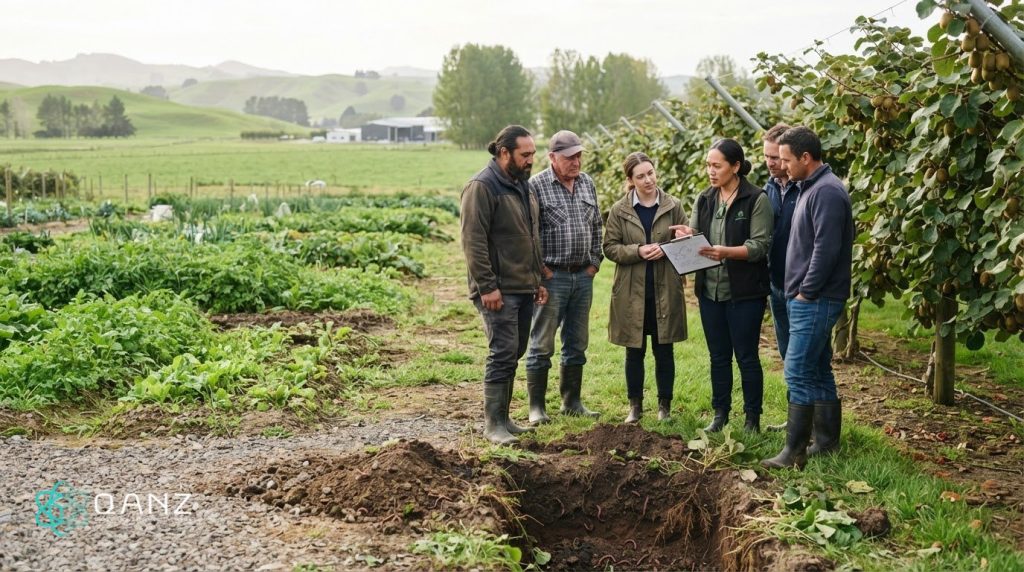
What if the best way to build support for a sustainable farming change is not to make a bigger promise, but to make the decision easier to assess? If you’re working out how to get buy-in for sustainable farming practices, start with the farm’s specific challenges and the people who’ll be affected, not a generic sustainability agenda.
It’s reasonable for owners, staff, family members and advisers to weigh benefits and risks differently. The effort and disruption can be immediate, while improvements may take time to assess. A practice that suits one crop, soil type or region may not fit another, so questions and reservations deserve a clear, evidence-led response.
This article sets out a practical process for building shared understanding, comparing options against agreed farm priorities and choosing measures that can be reviewed. You’ll learn how to shape a manageable trial, clarify who is responsible and set review points before committing to wider change. The aim isn’t to secure agreement at any cost. It’s to help everyone make an informed decision based on relevant evidence and what happens on your farm.
Key Takeaways
- Start with a specific farm challenge and agree on the priorities that matter to the people involved.
- Compare options against shared criteria, including agronomic fit, labour and uncertainty.
- Separate changes to farm practices from product inputs, and assess each on its own evidence and requirements.
- Before testing a change, agree on responsibilities, what to observe and when stakeholders will review the decision.
- Use product and application information to assess whether a biological input fits your farm, without treating it as proof of a particular outcome.
How to Get Buy-In for Sustainable Farming Practices: Why Support Can Be Difficult
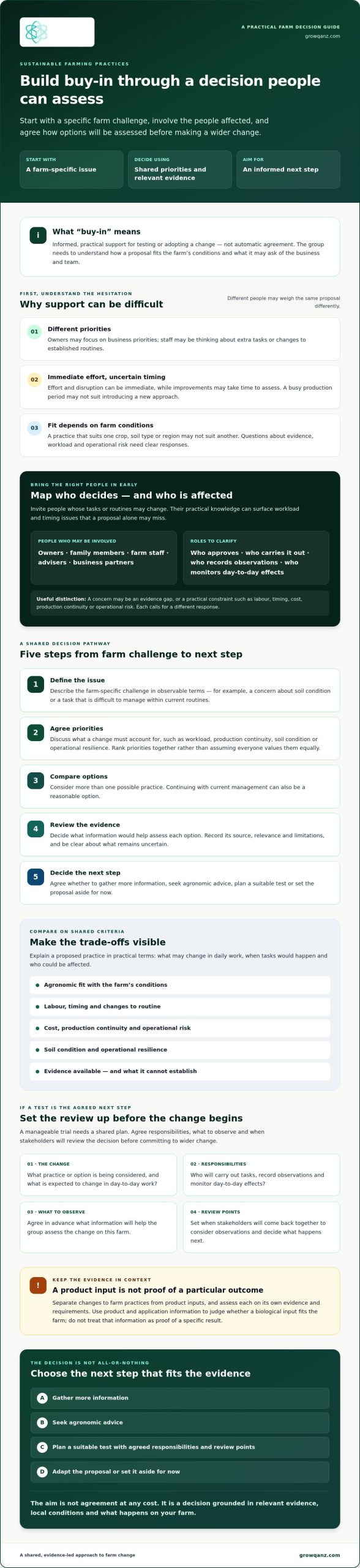
To understand how to get buy-in for sustainable farming practices, begin with the farm’s shared priorities, people’s concerns and a decision that feels manageable. Buy-in means informed, practical support for testing or adopting a change, not automatic agreement. People need to see how a proposal fits the farm’s conditions and what it could ask of the business and team.
Agreement can be difficult because a practice may affect people differently. An owner might focus on business priorities, while staff consider extra tasks or changes to established routines. Timing matters too: a new approach may be hard to introduce during a busy production period. Stakeholders may also differ in how much evidence they need before accepting uncertainty or operational risk.
Sustainability isn’t one fixed method. It can refer to different environmental, economic and social priorities, expressed through a range of practices. The overview of Sustainable agriculture describes this breadth, but it can’t determine what suits a particular farm, crop or season. A useful discussion translates broad aims into a specific farm issue and a decision people can assess.
Who needs to support a change on a farm?
Map who has a say and who will feel the effects. This may include owners, family members, farm staff, advisers and business partners. Then distinguish who approves a change from who carries it out, records observations or monitors day-to-day effects. These roles can overlap, but making them clear helps prevent decisions being made without the people responsible for putting them into practice.
Invite anyone whose tasks or routines may change into the discussion early. Their practical knowledge can reveal timing or workload issues that aren’t obvious from a proposal alone. Early involvement doesn’t require everyone to agree; it gives people a chance to identify what the decision needs to account for.
What concerns can slow a sustainable farming decision?
Ask stakeholders to name their concerns before presenting a preferred solution. Separate questions about evidence from practical constraints such as labour, timing, cost, production continuity or operational risk. Each calls for a different response: an evidence gap may need further information, while a workload concern may require a clearer plan for tasks and responsibilities.
Don’t assume hesitation means someone opposes sustainability. They may be protecting essential farm operations or seeking confidence that a proposed practice fits local conditions. Treating concerns as useful information helps the group identify what it needs to resolve before deciding whether to proceed, adapt the proposal or wait for a more suitable opportunity.
How Do You Build a Shared Case for Sustainable Farming Practices?
Build a shared case by starting with a specific farm challenge, agreeing what matters to the people involved, then comparing practical options against relevant evidence. This keeps the discussion grounded in local conditions rather than broad sustainability claims or a product recommendation. It also makes clear what the group knows, what remains uncertain and what decision is needed next.
A useful process has five steps:
- Define the issue. Describe the farm-specific challenge in observable terms, such as a concern about soil condition or a task that is difficult to manage within current routines.
- Agree priorities. Ask the group to rank what a change must account for, such as workload, production continuity, soil condition or operational resilience.
- Compare options. Consider more than one possible practice, including continuing with current management if that is a reasonable option.
- Review the evidence. Decide what information would help the group assess each option, and record the evidence’s source, relevance and limitations.
- Decide next steps. Agree whether to gather more information, seek agronomic advice, plan a suitable test or set the proposal aside for now.
Rank priorities together rather than assuming everyone values them equally. Then explain the proposed practice in practical terms: what might change in daily work, when tasks would happen and who could be affected. Sustainable agriculture can involve economic, environmental and quality-of-life aims; Sustainable Agriculture Research and Education (SARE) summarises these as three common goals. Use that broad framework to prompt discussion, not as proof that a particular practice will suit your farm.
For a clear comparison, record the same questions for each option:
| Factor | Questions to ask |
|---|---|
| Fit | Does it suit this crop, site and production system? |
| Tasks and resources | What work, materials or changes to routine may be required? |
| Uncertainty | What evidence is relevant, and what remains unknown? |
| Review measures | What observations would help the group assess the change? |
How should you assess evidence without overstating it?
Identify whether information comes from peer-reviewed research, independent trials, supplier material or grower observations. Each source can inform a discussion, but they don’t carry the same context or answer every question. Check whether the evidence relates to the same formulation, crop, location and growing conditions. If those details differ or aren’t available, state that limitation and record the unknowns instead of treating a potential benefit as certain.
If a biological input is one option under consideration, use current product information to check its stated suitability and application details. QANZ product information can form part of that wider comparison, but it isn’t evidence that a proposed practice will succeed.
How Can You Compare Sustainable Farming Options Without Overpromising?
Compare each option against the same farm-specific criteria: agronomic fit, labour, timing, inputs, uncertainty and monitoring needs. Separate a change to farm practice from adding a product input, and assess each on its own evidence. This gives stakeholders a fair basis for discussion without implying that any approach will deliver a particular result.
Start with the crop, production system, soil conditions and intended timing. Then ask what implementation could involve: staff time, equipment, coordination between workers or changes to existing operations. If key details are unclear, note what current technical guidance or independent agronomic advice is needed before making a decision. These questions make the process practical, rather than a contest of broad claims.
Use a consistent comparison template
Record what’s known and what still needs checking for each option. Leave figures blank until they’re supported by current, relevant information for your farm.
| Criteria | Questions to record |
|---|---|
| Agronomic fit | Does it suit the crop, production system, site and soil conditions? |
| Labour and timing | What tasks or coordination may be needed, and when? |
| Inputs and resources | What materials, equipment or other resources need confirming? |
| Uncertainty | What evidence is relevant, and what remains unknown? |
| Monitoring | What observations or measures will the group use to review the option? |
| Farm-specific figures | Insert verified rates, costs or performance information only when available and applicable. |
Keep recommendations and requirements specific to the country they come from. Growers in New Zealand should check current New Zealand guidance and product information for their circumstances. Australian or overseas recommendations shouldn’t be assumed to apply. For example, USDA support for sustainable farming describes United States programmes, so it may illustrate types of assistance available elsewhere but isn’t New Zealand guidance or confirmation of local support.
Assess biological inputs as one part of the programme
A biological input is one possible component of a wider crop or soil programme, not the same thing as changing a farm practice. Neither should be presented as a guaranteed outcome or as a replacement for other inputs. Quantum Organic-Total® is a microbial agricultural input offered by QANZ for use in crop and soil programmes. Growers considering it can review Quantum Organic-Total® product information and check current QANZ technical information for suitability and application requirements. Product suitability, rates and certification requirements should be checked against current QANZ technical and BioGro documentation.
State the limits of the information alongside any potential benefits. Evidence from another formulation, crop, location or set of conditions may not answer the question your group is weighing. A clear comparison makes those gaps visible, helping stakeholders decide whether to seek advice, gather more information or consider a carefully monitored next step.
How Do You Run a Manageable Trial and Keep Stakeholders Involved?
A manageable trial turns a proposed change into a planned decision, not a promise of success. Proceed only when agronomic advice supports the test and the people involved understand operational risks. Before starting, agree on the question, responsibilities, comparison conditions, observations and review date. Set out what would trigger a pause or adjustment, so the farm can respond if conditions or operations change.
What should a farm practice trial plan include?
Keep a written plan that everyone involved can refer to. Record:
- The question: What does the group want to learn, and what decision could the findings inform?
- The practice and context: Describe the proposed change, crop, site, timing and relevant conditions.
- Responsibilities: Name who carries out the work, collects observations and keeps the record.
- Comparison conditions: Agree what the test will be compared with, where appropriate, and note any differences that could affect interpretation.
- Measures and review: Choose observations stakeholders consider useful and practical to collect consistently, then set a review date.
- Pause or adjustment points: Document what operational issue or unexpected change would lead the group to stop, modify or seek further advice.
Where possible, record relevant baseline observations before the change begins, then use the same approach for follow-up. Measures should suit the question being tested and the farm’s ability to collect them. Don’t add data collection that staff can’t reliably maintain. Weather, timing, management differences or other conditions may influence what is observed. Record these factors, along with gaps in the plan, so findings aren’t treated as universal evidence or assumed to show a positive effect.
How can you review results and keep the conversation open?
At the agreed review, bring stakeholders together and compare observations with the measures and expectations set in advance. Include mixed or inconclusive findings, and give people who carried out the work space to explain practical effects. The outcome may be to continue, adjust, seek more advice or stop. A review is useful even when it doesn’t support wider adoption, because it clarifies what the group learned and what remains uncertain.
If the discussion concerns field crops, relevant field-crop biological programme information may help the group consider crop context. It shouldn’t be treated as proof that a practice or input will succeed on the farm. For questions about QANZ product and application information, review QANZ information about your crop and programme and assess any relevant details within the trial plan. This measured approach keeps decisions grounded in farm observations rather than assumptions.
How Can QANZ Support an Informed Decision on Sustainable Farming Practices?
Good buy-in comes from choosing a change that fits the farm’s priorities, conditions and available evidence, then agreeing how the decision will be reviewed. GrowQanz can help growers understand its products and application information, but that information isn’t proof that a practice or input will succeed on a particular farm. Keep the decision framework independent: assess agronomic fit, identify what remains uncertain and seek relevant advice before committing.
For background on GrowQanz’s approach, read its technology information. Treat this as product context, not a substitute for evidence that a specific practice will deliver a particular outcome in your crop or growing conditions.
What should growers verify before considering Quantum Organic-Total®?
Quantum Organic-Total® is a microbial agricultural input offered by GrowQanz for use in crop and soil programmes. Before considering it, check current GrowQanz technical information for suitability and application details relevant to your crop and programme. Confirm any rates against current documentation rather than relying on assumptions or information for a different formulation.
If certification requirements matter to your decision, check current BioGro documentation and confirm that the input is suitable for your own certification programme and intended use. Using an input doesn’t make a crop, farm or produce organic, and product information shouldn’t be taken as a guarantee of an agronomic, financial or environmental result.
What is a practical next step after building buy-in?
Capture the shared question, stakeholder concerns, evidence still needed and who is responsible for each decision. If the group is considering a product input, ask an appropriate adviser about agronomic fit and seek current product and application information before choosing a programme. Where the proposed change is broader than an input, keep evaluating the practice on its own merits and farm-specific evidence.
A cost-benefit assessment is relevant only if the group is evaluating Quantum Organic-Total® specifically. Use verified, farm-specific figures for any assessment and keep unknowns visible. Don’t treat possible benefits as established results.
For product and application information to support that evaluation, contact GrowQanz to discuss whether Quantum Organic-Total® may be appropriate for your crop, growing system and application programme. The decision to proceed, gather more evidence or hold off should remain grounded in your farm’s priorities, conditions and review criteria. That’s a practical way to build informed support without asking stakeholders to accept an outcome in advance.
Make the Next Farming Decision Together
Building support for change doesn’t require certainty about every outcome. It takes a shared understanding of the farm’s priorities, an honest look at relevant evidence and a clear plan for assessing what happens next. That’s the practical foundation for how to get buy-in for sustainable farming practices.
Keep the decision grounded in local conditions. Compare options against agreed measures, involve the people responsible for putting them into practice, and treat a trial as a way to learn, not a promise of success. If the evidence is incomplete, record what needs checking before moving forward.
QANZ supplies Quantum agricultural biological products to growers in New Zealand and Australia, and provides product and application support. For product suitability, rely on current technical information and consider how it fits your crop, growing system and programme. Talk to QANZ about whether Quantum Organic-Total® may be appropriate for your crop, growing system and application programme.
Thoughtful, shared decisions can help your farm explore change at a pace that makes sense for the people and conditions involved.
Frequently Asked Questions
How do you get farmers to adopt sustainable practices?
Start with a farm-specific issue, listen to the people affected and agree on priorities before comparing practical options. A useful approach to how to get buy-in for sustainable farming practices is to use evidence relevant to the crop and conditions, then propose a manageable, monitored next step rather than asking for an immediate whole-farm commitment. Fit depends on the individual farm, crop, local conditions and available agronomic guidance.
What are the main barriers to adopting sustainable farming practices?
Possible barriers include workload, timing, perceived production risk, unclear evidence and competing farm priorities, but these won’t apply equally to every operation. Ask stakeholders which concerns matter on their farm, then separate evidence gaps from implementation constraints. For example, the team may need better information about an option, or a practical plan for fitting new tasks into existing routines. Disagreement doesn’t necessarily mean opposition to sustainability.
How can a farm measure whether a sustainable practice is working?
Define the question and relevant measures before starting, then record a baseline where practical and note the conditions around each observation. Use a consistent method for follow-up and review the findings against the farm’s agreed criteria. Choose measures with help from credible technical advice so they suit the practice and can be collected reliably. Observations from one farm don’t guarantee the same result elsewhere, especially when conditions differ.
Should a farm trial a sustainable practice before adopting it widely?
A limited test may be worth considering if agronomic advice supports it, the test is manageable and operational risks are understood. Before starting, agree who is responsible, what the comparison conditions are, which measures will be recorded and when the group will review them. A trial can produce mixed or inconclusive findings. Treat it as a way to inform a decision, not as a promise of future performance.
How do you convince farm staff to support a new practice?
Involve staff early, explain the farm issue in practical terms and ask what might make implementation difficult. Clarify responsibilities and any training or guidance needed, then invite feedback during a test or implementation. Share what the group observes, including results that don’t match expectations. Avoid presenting the decision as settled before the people doing the work have had a genuine opportunity to raise concerns and contribute their practical knowledge.
Can biological inputs be part of sustainable farming practices?
Biological inputs may be considered as one option within a broader crop or soil programme, subject to product suitability and current technical information. Products can differ, so don’t assume they work in the same way or that one replaces conventional inputs. For Quantum Organic-Total®, check current QANZ technical and BioGro documentation for suitability, application details and any certification requirements relevant to your intended use.
How can growers compare sustainable farming options in New Zealand and Australia?
Compare options using shared criteria such as farm fit, evidence, workload and monitoring needs, then check agronomic recommendations and requirements separately for New Zealand and Australia. Advice may not transfer between countries, crops or growing conditions. Consult current local guidance and record where the evidence comes from, which crop and conditions it concerns, and how closely it matches the farm decision. This helps keep comparisons relevant and avoids treating overseas advice as local confirmation.
Disclaimer
Important: This article provides general agricultural information only. Product performance can vary according to crop, soil, climate, management practices and application conditions. Trial or research results discussed may have been obtained under specific conditions and should not be interpreted as a guarantee of equivalent results. Always follow current product directions and confirm suitability for your crop, growing system and organic certification requirements. Contact QANZ for current product and application information.
