
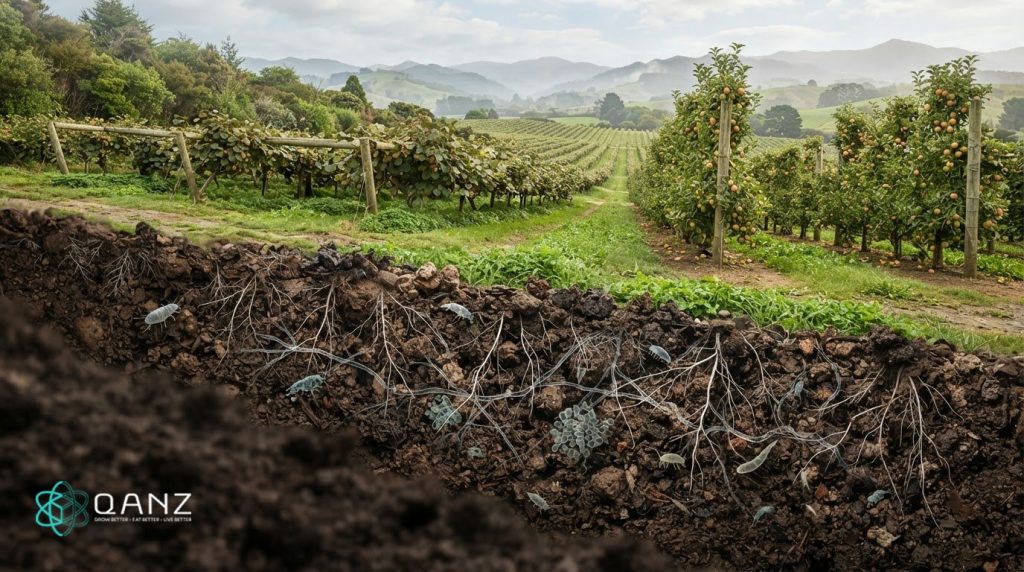
Soil microbiology for orchards is the study of microscopic life in orchard soils and how it interacts with roots, organic matter and the wider soil community. Bacteria, fungi and other microorganisms live in conditions shaped by the orchard, so understanding their role means looking at the soil, crop and management together, rather than relying on a one-size-fits-all microbial claim.
For growers, the challenge is knowing which conditions to assess and what soil biology tests or research claims can actually tell you. Advice from another crop or country may not fit your orchard’s soil, climate or management system.
This guide explains how orchard conditions influence soil communities, how to interpret measurements and evidence, and which management factors to review before changing a programme. It also outlines practical questions for evaluating biological inputs using product-specific documentation, with New Zealand growers in mind.
Key Takeaways
- Soil microbiology for orchards includes microorganisms within a wider living system of soil fauna and plant roots.
- Interpret microbial activity in context: organic matter, available carbon, moisture, temperature, aeration and pH interact.
- Before changing a programme, define the orchard question, review management records and assess relevant soil conditions.
- Use soil measurements, biological indicators and research for their specific purposes. Recognise what each can and can’t establish.
- Evaluate microbial inputs against crop suitability, intended use, evidence and current product documentation. General soil science isn’t proof of a particular product’s performance.
What does soil microbiology mean for an orchard?
Soil microbiology for orchards is the study of microscopic organisms living in soil and how they interact with roots, organic matter and one another. These organisms form part of a wider soil community that also includes larger soil fauna and plant roots. Their abundance and activity vary with soil properties, crop, management and environmental conditions. There is no single microbial profile that defines every healthy orchard.
The term “microorganisms” commonly covers bacteria, fungi and archaea, as well as microscopic organisms such as some protozoa. Soil fauna includes animals such as nematodes, mites and earthworms, while living roots are part of the wider below-ground system rather than microorganisms themselves. These groups differ in how they obtain energy, interact with other organisms and respond to their surroundings. The presence of any one group doesn’t show that it provides the same benefit in every soil. Context and appropriate measurements matter. The Soil microbiology overview offers a starting point for understanding the field. Orchard interpretation still depends on local conditions.
Which organisms are part of orchard soil biology?
Bacteria and archaea are single-celled organisms with diverse ways of living. Fungi range from microscopic forms to networks of filaments, and soil fauna includes organisms that feed on plant material, microbes or other soil animals. Their interactions contribute to a complex community, but a group’s presence alone doesn’t show whether a particular soil process is occurring at a useful rate. Context and appropriate measurements matter.
Why does the orchard context matter?
Many orchards contain perennial trees or vines, with roots that remain in place across seasons. That differs from annual cropping, where crops are generally established and removed within a shorter cycle. However, root distribution, active growth periods and soil conditions vary between orchard blocks, so the perennial label doesn’t tell the whole story.
For example, the root-zone environment in kiwifruit, grapes, apples or blueberries may differ with soil type, planting layout, crop stage and management. The rhizosphere is the soil zone influenced by living roots, including through root growth and substances released by roots. Its conditions can differ from soil farther away and change over time.
Orchard floor management adds another layer of variation. A block may have managed vegetation, bare strips, mulched areas or different approaches between rows and beneath trees. Traffic, cultivation, irrigation patterns and organic matter inputs can also vary between properties. Assess the relevant block and root zone rather than assuming findings from another crop, orchard or overseas study apply unchanged.
How do orchard conditions shape soil microbial communities?
Soil organisms respond to the resources and habitat available to them. Organic matter supplies carbon in forms organisms can use, but its effect depends on the material, how quickly it decomposes and the surrounding conditions. Groundcover residue, mulch and other organic inputs may therefore interact differently with different soils and at different times of year.
Microbial communities respond to interacting soil, plant and management conditions. Moisture, temperature, aeration and pH don’t act as separate switches. Soil texture and structure influence how water and air move, while weather, roots and orchard practices also shape those conditions. Consider the biological, physical and chemical dimensions of orchard soil health, then interpret them in relation to your own block.
How do moisture, pH and compaction influence soil biology?
Water availability and temperature influence microbial activity, but wetter or warmer conditions aren’t automatically better. Poor drainage or compaction can restrict air movement, while dry soil can limit available moisture. Soil pH also helps determine which organisms can persist and how nutrients behave. The combined effect depends on soil type and structure, season and recent management.
Interpret observations and test results together. A pH reading, for example, is one part of the picture; it doesn’t describe soil biology on its own. Consider where and when a sample was taken, soil conditions at the time, and whether cultivation, irrigation or other management may have influenced the result. Don’t apply a target value from another crop or region without checking its relevance to the orchard.
What role do roots, groundcover and organic matter play?
Living roots influence the rhizosphere, the soil zone around them, through root growth and substances released by roots. Groundcover brings additional roots and plant residues into the orchard floor, and organic materials can provide carbon. These are useful considerations for planning management, but they don’t guarantee a particular change in microbial activity. Their relevance depends on the crop, soil, placement and existing orchard system.
Cultivation, traffic and groundcover management can alter the soil habitat. Their effects vary with soil condition and how each practice is carried out. A kiwifruit block, vineyard or apple orchard may have different root-zone patterns and floor-management constraints, even within the same broad region. Observe where roots, groundcover and organic matter occur, then relate those observations to moisture and soil structure before deciding what to adjust. This context-specific approach is central to understanding soil microbiology for orchards.
If you’re considering a biological input as part of a broader soil programme, talk with GrowQanz about product and application support.
How can growers assess orchard soil microbiology and evidence?
Start with a clear question: are you investigating soil chemistry, physical condition, a biological process or a claim about a specific input? Different measurements answer different questions. No single test provides a complete picture of orchard soil biology, and a laboratory result needs to be interpreted alongside the block’s history and growing conditions.
Keep sampling consistent so results can be compared meaningfully. Record the location, sampling depth, date or season, crop stage, recent soil or crop management, and whether the sample came from beneath the canopy, an under-vine strip or the row middle. Follow the laboratory’s sampling instructions. Avoid comparing results from different locations or methods as though they were directly equivalent. QANZ does not sell laboratory testing services, so growers seeking analysis should contact a suitable independent provider.
Which soil tests can help answer an orchard question?
Routine soil chemistry tests can help assess measures such as pH and nutrient status. Biological assays have different purposes. Depending on the method, they may estimate microbial biomass, activity or aspects of community composition. Ask the laboratory what the assay measures, how samples should be collected, and what its interpretation can and can’t support. A DNA-based profile, for example, isn’t by itself a complete measure of microbial activity or a diagnosis of orchard performance.
Use biological indicators alongside relevant physical and chemical observations, such as soil structure, drainage or compaction. Don’t treat a single assay as a universal score or assume that a result identifies the cause of a crop issue. Interpretation depends on sampling, soil type, season and management context.
How should growers judge microbial research claims?
First identify the type of evidence being presented. General peer-reviewed research can explain biological processes. Laboratory studies examine organisms or materials under controlled conditions. Independent field trials test treatments in a particular setting. Manufacturer trials are conducted or commissioned by a product supplier, while commercial observations describe experience outside a controlled trial. Each can inform a decision, but they don’t carry the same implications.
For a trial, check the exact crop, product formulation, location, treatment, comparison and growing conditions. Also check what was measured and whether the reported result comes from replicated field work or a laboratory setting. Evidence about one formulation doesn’t automatically establish the performance of another.
A laboratory finding is not automatically a field recommendation. Overseas results may help frame a question, but they don’t establish that the same outcome will occur in a New Zealand or Australian orchard. For soil microbiology for orchards, weigh each finding against local soil, climate, crop and management. Keep general research separate from evidence for a specific product.
What orchard practices can support a considered soil biology programme?
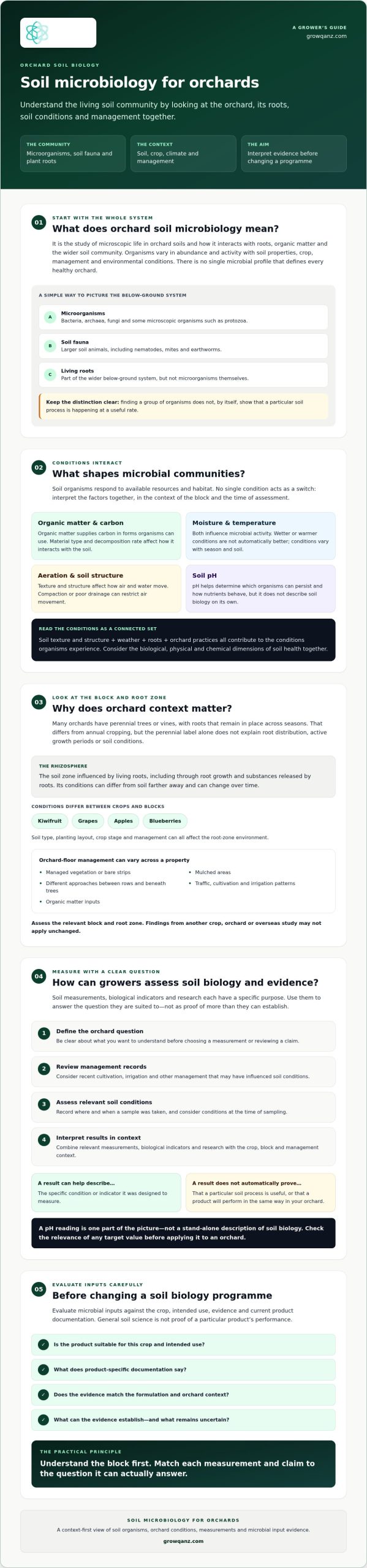
A useful soil biology programme starts with a defined orchard question, not a product or practice chosen in isolation. Follow a clear sequence: set the question, review block records, assess relevant conditions, then evaluate options. This gives you a reference point for considering changes in light of the orchard’s needs.
How can growers build a useful orchard soil baseline?
Record the soil type, crop and block history, groundcover, irrigation context and recent management. Note where observations or samples are taken, including depth and position relative to the tree or vine row. Keep methods consistent over time, and seek qualified interpretation for crop-specific decisions. The Washington State University orchard soil health resource offers general background, but its recommendations shouldn’t be assumed to apply directly to New Zealand orchards.
- Define the orchard question. Be specific about what you want to understand, such as soil structure, water movement or the implications of a proposed management change.
- Review records. Look across previous soil results and notes on cultivation, groundcover, organic matter additions, irrigation and traffic. Check whether conditions differ between blocks or zones.
- Assess the relevant area. Use appropriate observations or tests, following consistent sampling guidance. Interpret results in light of the crop, soil and management history.
- Evaluate options. Consider whether changes involving organic matter, carbon availability, moisture, pH, compaction, plant diversity or cultivation suit the block and its practical constraints. Check crop-specific advice before acting.
How should orchard practices be reviewed over time?
Groundcover and cultivation choices need to fit orchard operations, including access, traffic and water management. Organic matter sources and placement also depend on site conditions and the existing programme. A practice that suits one part of an orchard may not suit another, so record where and when changes are made.
Seasonal conditions vary across New Zealand and Australia, as do local crops and sites. Use relevant local guidance and observations from the block when considering timing. Don’t assume a recommendation transfers directly between regions. Where practical, adjust one manageable factor at a time and note what changes across comparable locations and seasons. This supports careful review, but doesn’t by itself prove that a single input caused an outcome.
Consistent records help growers review soil management over time. If you’re considering a biological input, talk to QANZ about product and application support.
How should growers evaluate microbial inputs for orchard soil programmes?
Assess a microbial input against a defined orchard need, not broad claims about soil biology. General research can explain how soil organisms function, but it doesn’t establish that a particular product will perform in a particular crop, soil or growing system. Check product-specific evidence and current documentation before deciding whether an input belongs in your programme.
What should growers check before considering a biological input?
Use this checklist to assess an option:
- Crop suitability: Is the product documented as suitable for the crop and intended growing system?
- Intended use: What use does current technical information specify, and what application guidance does it provide?
- Evidence: Does the evidence relate to the exact formulation, crop and conditions? Distinguish laboratory work, field trials and commercial observations.
- Documentation: Are product details, directions and any relevant certification information current and available for review?
- Compatibility: Check whether the proposed use fits your existing soil and crop programme. Confirm compatibility questions with the product supplier.
Ask for current technical information on suitability, rates and intended application rather than relying on general microbial research or recommendations for another product. If you operate under a certification programme, confirm input suitability and permitted use with your certifier using current documentation. New Zealand and Australian availability, seasonal timing and recommendations may differ, so verify the relevant details for your location directly.
Where does Quantum Organic-Total® fit in an orchard discussion?
Quantum Organic-Total® is a microbial agricultural input offered by QANZ for use in crop and soil programmes. Product suitability, rates and certification requirements should be checked against current QANZ technical and BioGro documentation. This description doesn’t establish orchard-specific performance or suitability for every crop and use. Review current product information and evidence for the exact formulation, and assess it alongside your orchard question, existing management and available options.
Keep the evidence lines clear: findings about soil microbiology generally aren’t proof of the performance of Quantum Organic-Total®, and evidence for one microbial product shouldn’t be transferred to another. Check the crop, location, treatment and conditions behind any trial claim, and don’t treat a result as a guaranteed outcome.
For further product details, read the Quantum Organic-Total® product information. Growers considering it for an orchard can talk to QANZ about whether it may be appropriate for their crop, growing system and application programme.
Make soil decisions with confidence
Sound soil microbiology for orchards starts with the conditions in your own block. Soil organisms respond to interacting factors, so combine consistent observations and relevant measurements with crop needs and management history. Then assess research and biological inputs carefully: general findings about soil microbes don’t prove the performance of a particular product.
QANZ supplies Quantum agricultural biological products to growers in New Zealand and Australia. Quantum Organic-Total® is a microbial agricultural input offered by QANZ for use in crop and soil programmes. Check current technical information for suitability, application guidance and other product details before considering its use in an orchard programme.
Every orchard has its own context. Keep building your understanding through considered decisions, and talk to QANZ about your crop and soil programme if you’d like to discuss whether a biological input may be suitable.
Frequently Asked Questions
What is soil microbiology in an orchard?
Soil microbiology for orchards is the study of microscopic organisms in soil, including bacteria, fungi and archaea, and how they interact with roots and other parts of the soil community. The rhizosphere, the soil zone influenced by living roots, is one important setting for these interactions. Microbial communities vary with soil, crop, management and environmental conditions, so orchard soils don’t all contain the same community.
Why is soil microbiology important for fruit trees?
Soil microorganisms contribute to processes such as breaking down organic matter and cycling nutrients. These processes are part of the broader soil environment that supports fruit tree roots, but they don’t guarantee a particular crop response. Consider soil biology alongside factors such as soil structure, moisture, pH, nutrient status and orchard management. Understanding these interactions can help growers frame better questions about their soil and make more informed decisions.
How can I improve soil microbial activity in an orchard?
Start by identifying a specific soil or management concern, then review block records and assess relevant conditions before choosing an intervention. Consider organic matter and carbon availability, moisture, pH, compaction, groundcover diversity and cultivation practices in context. Where practical, adjust one manageable factor at a time and record what changes. Don’t assume that one practice or input will produce the same biological response across different soils, crops or seasons.
Can soil biology be measured with a soil test?
Some laboratory methods assess biological indicators, such as microbial activity or aspects of community composition, while routine soil tests commonly focus on chemical properties such as pH and nutrient status. Each method answers a different question and has limitations; no single test gives a complete picture of soil biology. Ask the laboratory about sampling requirements, method and interpretation. QANZ does not sell laboratory testing services.
Do microbial soil products make an orchard organic?
No. Using a microbial soil product does not, by itself, make an orchard, crop or produce organic. If your orchard operates under an organic certification programme, check whether the specific input and intended use meet that programme’s requirements. Confirm this using current product documentation and guidance from your certifier. Certification status and input approval can be specific to the product, its use and the relevant certification programme.
Is Quantum Organic-Total® suitable for every orchard crop?
Suitability shouldn’t be assumed for every crop or orchard system. Before considering it, check current QANZ technical information for crop suitability, intended use, rates and application guidance. Growers should also confirm any certification requirements for their own programme and intended use, rather than relying on general descriptions of microbial inputs.
Do overseas microbial trials show the same results in New Zealand or Australia?
No. Overseas trial findings don’t establish that the same result will occur in New Zealand or Australia, where crop, soil, climate and management conditions may differ. Check the exact formulation, crop, location, treatment, comparison and trial conditions, and distinguish field trials from laboratory studies or commercial observations. Evidence for one product or formulation also shouldn’t be treated as proof for another. Interpret findings as specific to the conditions tested.
Disclaimer
Important: This article provides general agricultural information only. Product performance can vary according to crop, soil, climate, management practices and application conditions. Trial or research results discussed may have been obtained under specific conditions and should not be interpreted as a guarantee of equivalent results. Always follow current product directions and confirm suitability for your crop, growing system and organic certification requirements. Contact QANZ for current product and application information.
