
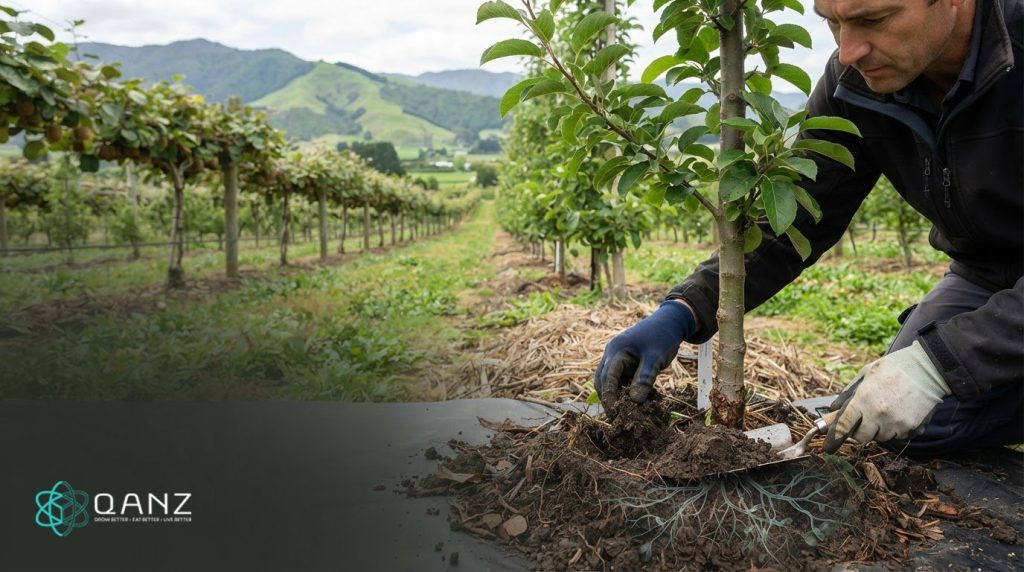
Choosing microbial inoculants for fruit trees starts with matching the product’s intended use and evidence to your orchard, not with a promised result. Consider the crop, soil conditions and existing programme, then check information for the exact formulation. General research into soil biology can provide context, but it doesn’t show how a specific product will perform in your orchard.
Before adding an input, ask what it is intended to do and what evidence supports that use. Recommendations are harder to compare when they relate to a different crop, country or growing system, and broad claims can leave important details unclear. A measured decision checks the product information, supporting evidence and conditions that could affect its relevance.
This guide explains how microbial inputs may fit into fruit-tree soil programmes, which orchard and product details to assess, and how to weigh research and claims for New Zealand and Australian conditions. It also outlines a practical way to document your decision, so any evaluation reflects your orchard rather than assumptions drawn from elsewhere.
Key Takeaways
- Microbial inoculants for fruit trees are inputs containing microorganisms. They aren’t interchangeable with fertilisers, soil amendments or pest-control products.
- Review orchard context, including soil organic matter, moisture, pH, compaction, carbon availability and cultivation history, before assessing product fit.
- When comparing evidence, record the formulation, crop, location, treatment, conditions and measured outcome. Research on one product or crop may not apply to another.
- Use a clear process: define the management question, review orchard conditions and product information, plan the use, then record observations.
- Quantum Organic-Total® is a microbial agricultural input for crop and soil programmes. Check its suitability, rates and certification requirements against current GrowQanz technical and BioGro documentation.
What are microbial inoculants for fruit trees?
Microbial inoculants for fruit trees are inputs containing microorganisms intended for crop or soil applications. Their intended use depends on the specific formulation and product information. An inoculant isn’t automatically a fertiliser, soil amendment or pest-control product, and these categories aren’t interchangeable. Assess the product’s documentation in relation to the crop, application method and growing conditions.
How does an inoculant differ from other orchard inputs?
A microbial inoculant contains microorganisms and is intended for a stated crop or soil use. A fertiliser supplies nutrients, a soil amendment is added to alter or support soil properties, and a pest-control product is intended to manage a pest. These are broad categories, not guarantees of what an individual product does.
Labels and technical documents describe an input’s intended use and application directions. Read them rather than inferring a function from terms such as “biological” or “microbial”. An inoculant shouldn’t be treated as a replacement for fertiliser or crop protection. If it fits the programme, it should be considered alongside the orchard’s other management needs.
What does soil biology mean in a fruit-tree system?
Soil biology refers to living organisms in soil, including bacteria, fungi and other microorganisms, within a wider ecosystem. A peer-reviewed review in Nature Reviews Microbiology discusses the complexity of soil microbial communities and the challenges of understanding them. For a general introduction to inoculant types, see Microbial inoculants.
This scientific context helps explain why growers consider soil life, but it doesn’t establish what a particular commercial product will do in a particular orchard. General research may involve a different organism, formulation, crop, application or set of conditions. Those differences matter when interpreting claims about fruit trees.
General soil biology describes living processes in soil; product-specific evidence shows what has been measured for a particular formulation and use.
For growers, this distinction helps keep expectations grounded. Treat soil biology as part of the orchard context, then assess an inoculant against evidence and directions for its exact formulation and intended application. Don’t assume general research predicts tree health or yield.
Reference: Fierer, N. “Embracing the unknown: disentangling the complexities of the soil microbiome.” Nature Reviews Microbiology 15, 579-590 (2017). nrmicro.2017.87.
Which orchard conditions matter when assessing microbial inoculants?
Assess the orchard before the product. Soil organic matter, moisture, pH, compaction, carbon availability and cultivation history help describe the root-zone environment and current management. These details provide context for judging whether product information and supporting evidence relate to your orchard. None, on its own, tells you whether an inoculant will be suitable or effective.
How can soil and orchard management shape the decision?
Start with records you already have, such as soil reports, block maps, irrigation and cultivation records, groundcover management, and notes on previous inputs. Consider where feeder roots are managed and whether conditions differ between blocks or between the tree row and inter-row. This helps define the intended application area and the programme an input would need to fit.
Review the indicators together:
- Organic matter and carbon availability: note what existing records say about soil organic matter and how organic materials or groundcover are managed.
- Moisture: consider typical and recent root-zone moisture alongside irrigation and drainage patterns.
- pH and compaction: treat recorded pH and signs of restricted soil structure as context, not automatic reasons to select or reject a product.
- Cultivation history: record practices that may have changed the soil surface or root-zone environment.
These factors don’t prove a product-specific mechanism or predict a result. They help you judge whether evidence from another orchard describes comparable conditions. Soil reports can inform that review, but no single measurement provides an answer about product fit.
Does fruit species change what evidence is relevant?
Yes. Kiwifruit, apples, citrus, stone fruit and grapes differ in their orchard systems, root-zone management and crop calendars. Evidence for one species or production context shouldn’t be treated as evidence for another without a clear reason. The same care applies across New Zealand and Australia: location, climate, cultivar, local phenology and management can affect how relevant an application schedule or trial is. Don’t assume a seasonal calendar transfers directly between regions.
For any claim, check whether the evidence matches the crop, formulation, application and conditions you’re considering. A general reference to fruit trees is less informative than details identifying the species and orchard context evaluated. For additional context on QANZ’s fruit and nut programmes, see fruit and nut crop information.
Define the question you want an input to address before comparing product claims. This anchors your assessment in orchard records and the existing programme, rather than relying on a recommendation detached from local conditions.
How can growers compare inoculant evidence and product fit?
Start by identifying the source of the evidence and what it tested. General research on microorganisms may explain biological processes, while a product trial or grower observation relates to a particular formulation and set of conditions. For microbial inoculants for fruit trees, compare the crop, formulation, application, location and measured outcome.
| Evidence type | What to record | How to interpret it |
|---|---|---|
| Independent research | Whether it studied general soil biology or a named product, plus crop, location, methods and outcomes. | General research can provide scientific context, but doesn’t establish the performance of a commercial formulation. |
| Manufacturer trial | Exact formulation, crop, location, treatment, comparison and conditions. | Product-specific information can be useful. Distinguish it from independent research and note who conducted it. |
| Overseas trial | Country, crop, formulation, application and growing conditions. | Keep the location explicit. A finding from another country shouldn’t be presented as a New Zealand or Australian result. |
| Commercial observation | Grower, orchard context, management, product formulation and observed outcome. | An observation can offer practical context, but may not show that the input caused the outcome. |
What should a useful trial or study report include?
Look for the exact product or formulation, crop and trial location, as well as treatment details, comparison method, growing conditions and measured outcomes. Check whether the report assessed yield, tree growth, soil characteristics or another specific measure. These are not interchangeable claims. Note what’s missing: if the source doesn’t identify a comparison or the conditions, interpret its conclusions cautiously.
How should growers interpret overseas or product-specific evidence?
Identify overseas findings by country; don’t describe them as New Zealand or Australian evidence. A result for one formulation also doesn’t establish a result for another. For example, evidence relating to Quantum VSC® shouldn’t be attributed to Quantum Organic-Total® unless QANZ documentation explicitly supports that connection.
Trial findings apply to the formulation, crop, application and conditions tested; they don’t automatically establish the same outcome in another orchard.
Separate a measured result from broader interpretations or promotional language. A study may report an association without showing that the product caused it, and a result from one trial isn’t a guarantee of future performance. The most useful basis for comparison is a clearly described study whose formulation and conditions match the question you’re assessing.
How should growers evaluate and use an inoculant in an orchard programme?
Begin with a clear management question, then assess whether the product’s intended use and supporting evidence fit the orchard. For microbial inoculants for fruit trees, follow current product directions and the requirements that apply in the country where the product will be used. Keep records from the outset so observations can be interpreted in context, without treating a change in one season as proof of cause.
What should growers check before an application?
Read the current product label and QANZ technical information for the intended use and application directions. If the orchard is managed under an organic certification programme, check whether the input is suitable for that programme and intended use. Requirements and product documentation may differ between New Zealand and Australia, so review the applicable information for each country rather than assuming guidance transfers across the Tasman.
How can an orchard evaluation stay useful and honest?
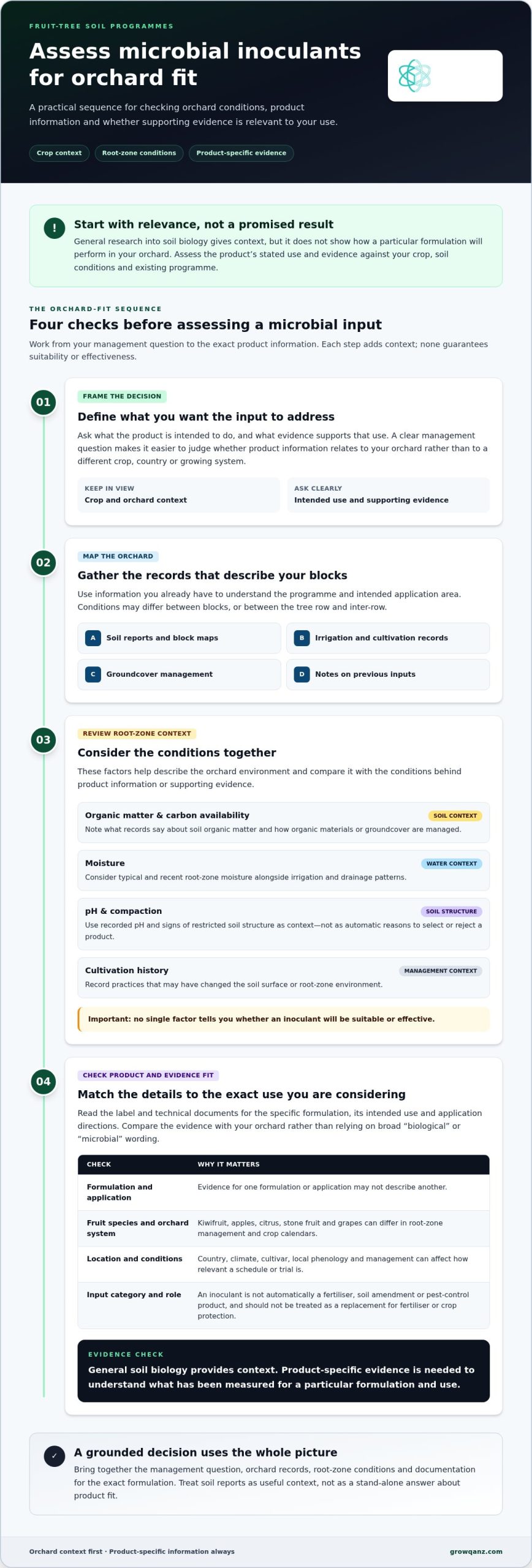
Decide what you’ll observe before starting. Choose practical measures that relate to your management question, and record them consistently. A structured process helps keep the decision focused:
- Define the question. State the orchard management issue the input is being considered for, without assuming the product will resolve it.
- Review the context. Note the crop, block, root-zone conditions and current management programme.
- Read the documentation. Confirm the exact formulation, intended use and directions in current label and technical material.
- Plan the evaluation. Decide what will be observed, when records will be taken and how other management changes will be noted.
- Record what happens. Document the formulation, application details, timing, crop stage, site conditions and observations, including changes in other practices.
Keep records specific. For example, note the treated block and crop stage alongside relevant weather or soil conditions, and log other inputs or management changes during the same period. This makes later comparisons more informative, though it doesn’t replace a well-designed trial.
A single observation can’t show that an inoculant caused a change. Weather, crop load, irrigation and other management decisions may also influence what you see. An observation in one block or season doesn’t predict results in another orchard. Describe what was observed, not a broader benefit that the evidence hasn’t established.
QANZ provides product and application support for growers. See QANZ’s information when considering how a biological input fits a crop and application programme.
Where does Quantum Organic-Total® fit in a fruit-tree programme?
Quantum Organic-Total® is a microbial agricultural input offered by QANZ for use in crop and soil programmes. Its fit in a fruit-tree programme depends on the intended use, orchard context and current product information. As with other microbial inoculants for fruit trees, a general description of the product category isn’t evidence of performance on a particular fruit species or in a particular orchard.
What can growers verify in current product information?
Start with the Quantum Organic-Total® product information and current QANZ technical documentation. Review the product’s stated intended use, suitability and application directions. Don’t infer a rate or crop suitability from general microbial research, another formulation or a recommendation for a different crop.
For organic production, check current certification documentation and confirm that the input is suitable for your own certification programme and intended use. An input’s status, where applicable, doesn’t make a farm, crop or produce organic. Certification requirements should be considered separately from agronomic fit.
QANZ’s fruit and nut crop information provides programme context. Read it alongside product-specific documentation, not as proof that Quantum Organic-Total® has been trialled on a particular fruit tree. Crop-specific conclusions require evidence identifying the exact formulation, species, location, application and measured outcome.
What is a practical next step for New Zealand and Australian growers?
Relate the product information to your own management question. Note the fruit species, country, growing system, orchard conditions and intended application programme, then assess how those details align with current directions and evidence. New Zealand and Australian guidance may differ; don’t assume seasonal timing or other recommendations transfer unchanged between countries.
Keep the decision measured. Product information should support an assessment of fit, not a promise of yield, fruit quality or another outcome. Discussing the crop and application context can help clarify what information to review next.
Explore QANZ’s product and application support for your crop, growing system and intended programme.
Make your next orchard decision evidence-led
Assess microbial inoculants for fruit trees against the orchard, intended use and evidence for the exact formulation, not broad biological claims. Soil conditions and management history help show whether a recommendation is relevant, while clear records make an orchard evaluation more useful.
Keep general soil biology separate from product-specific results. Check current product directions and documentation, and don’t assume findings from another crop, formulation or country will apply to your trees. A careful assessment helps you make a measured decision without treating an observed change as proof of cause or a promise of future results.
QANZ supplies Quantum agricultural biological products to growers in New Zealand and Australia. Quantum Organic-Total® is a microbial agricultural input for crop and soil programmes. Assess its suitability, rates and certification requirements using current documentation.
Use your crop, growing system and programme to guide the next step. Talk to QANZ about product and application support for your orchard.
Frequently Asked Questions
Do microbial inoculants work for fruit trees?
Whether an inoculant is suitable or delivers a particular outcome depends on its formulation, crop, treatment and growing conditions. General research about soil microorganisms doesn’t prove that a specific commercial product will produce the same effect. Look for evidence that names the exact formulation and describes the trial context. Treat any reported result as specific to the conditions tested, not a guarantee for another orchard.
How do I choose a microbial inoculant for an orchard?
Start by defining the management question and reviewing orchard records, including soil conditions, cultivation history and current crop practices. Then read the product’s current label and technical information for intended use and application directions. Compare evidence only when the formulation, crop and trial conditions are clear. New Zealand and Australian growers should assess relevant country-specific product documentation separately rather than assume recommendations transfer between markets.
Can microbial inoculants replace fertiliser in fruit production?
No. Don’t assume a microbial inoculant replaces fertiliser or another conventional input. Check documentation for the exact formulation and its stated intended use, and base nutrient decisions on the crop programme and appropriate agronomic information. If evaluating an input, record other management changes alongside observations. This helps avoid attributing an orchard difference to one product without evidence supporting that connection.
When should microbial inoculants be applied to fruit trees?
There isn’t one application timing that applies to every product, fruit tree or region. Follow the current product label and technical information, then consider crop stage, orchard conditions and local seasonal context. New Zealand and Australia have different climates and growing calendars, so a timing recommendation from one country shouldn’t automatically transfer to the other. Use directions for the specific formulation you’re considering.
Does using a microbial inoculant make fruit organic?
No. Using an input by itself doesn’t make a farm, crop or produce organic. If you operate under an organic certification programme, check whether the particular product and intended use meet that programme’s current requirements. Verify any certification statement against current official documentation. Input suitability and a farm’s organic status are separate matters, so don’t treat a product claim as proof that a crop is certified or compliant.
What evidence should I look for before using a microbial product?
Look for the exact formulation, crop, trial location, treatment, growing conditions and measured outcome. Identify the evidence type too: independent research, a manufacturer trial, overseas trial, laboratory study or commercial observation. These sources answer different questions and shouldn’t be treated as interchangeable. A finding for one formulation, crop or location doesn’t establish that another product will deliver the same result under different orchard conditions.
Disclaimer
Important: This article provides general agricultural information only. Product performance can vary according to crop, soil, climate, management practices and application conditions. Trial or research results discussed may have been obtained under specific conditions and should not be interpreted as a guarantee of equivalent results. Always follow current product directions and confirm suitability for your crop, growing system and organic certification requirements. Contact QANZ for current product and application information.
