
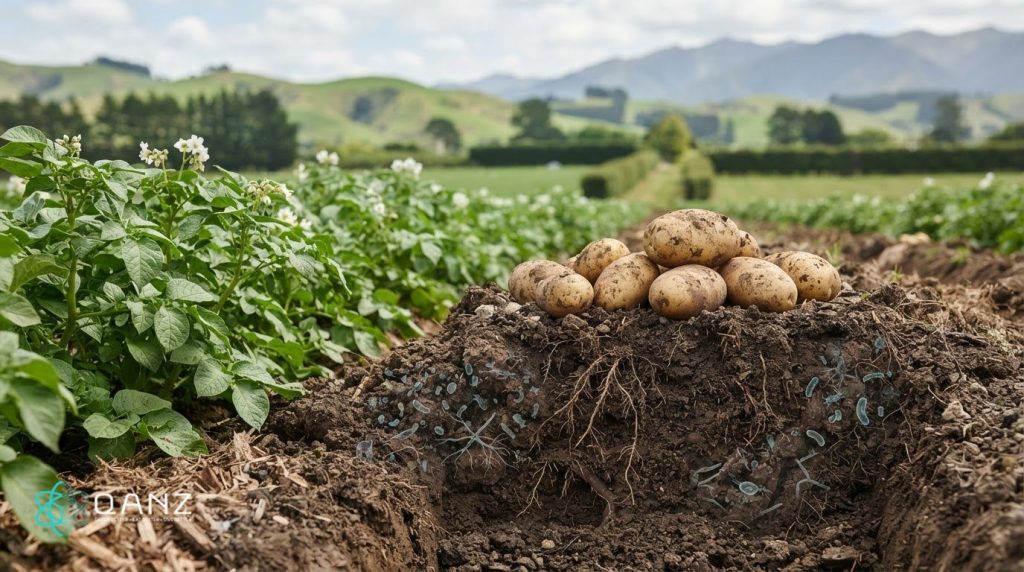
Could changing soil biology help with potato scab, or does the answer lie in managing the conditions that let disease take hold? Scabby tubers can lose visual appeal and marketability, but “potato scab” describes more than one problem. Common scab, caused by soil-dwelling bacteria, is associated with different conditions from powdery scab, which has a different causal organism. Reducing potato scab with soil biology therefore starts with identifying the disease and understanding field conditions, not assuming that one biological input will solve every case.
This guide explains how common and powdery scab differ, which soil and crop-management factors to investigate before planting, and why moisture, pH, rotation and cultivar choice may matter. It also outlines how to assess biological inputs against relevant evidence and current product information. Quantum Organic-Total® is a microbial agricultural input offered by GrowQanz for use in crop and soil programmes. This article does not establish it as a potato scab treatment. The practical approach is to manage risk first, then assess biological inputs as evidence-led additions to a broader crop programme.
Key Takeaways
- Distinguish common scab from powdery scab before choosing management steps, as they have different causes and risk conditions.
- Review soil pH, moisture, organic matter and paddock history to build a clearer picture of field-level risk.
- Approach reducing potato scab with soil biology as part of integrated management, not as a guaranteed result from a biological input.
- Record cultivar, paddock conditions, crop decisions and tuber symptoms to support diagnosis and review after harvest.
- Assess any biological input against evidence for the exact product and intended use. Quantum Organic-Total® is a microbial input for crop and soil programmes, not an established potato scab treatment in this article.
What causes potato scab, and why does diagnosis matter?
Soil biology is one consideration in potato scab management, not a guaranteed control method. “Scab” describes blemishes on tuber surfaces, but common scab and powdery scab have different causes and disease patterns. Accurate diagnosis helps growers interpret symptoms and investigate relevant field conditions before choosing management steps. A tuber’s appearance alone can’t confirm the cause or what contributed to it.
How do common scab and powdery scab differ?
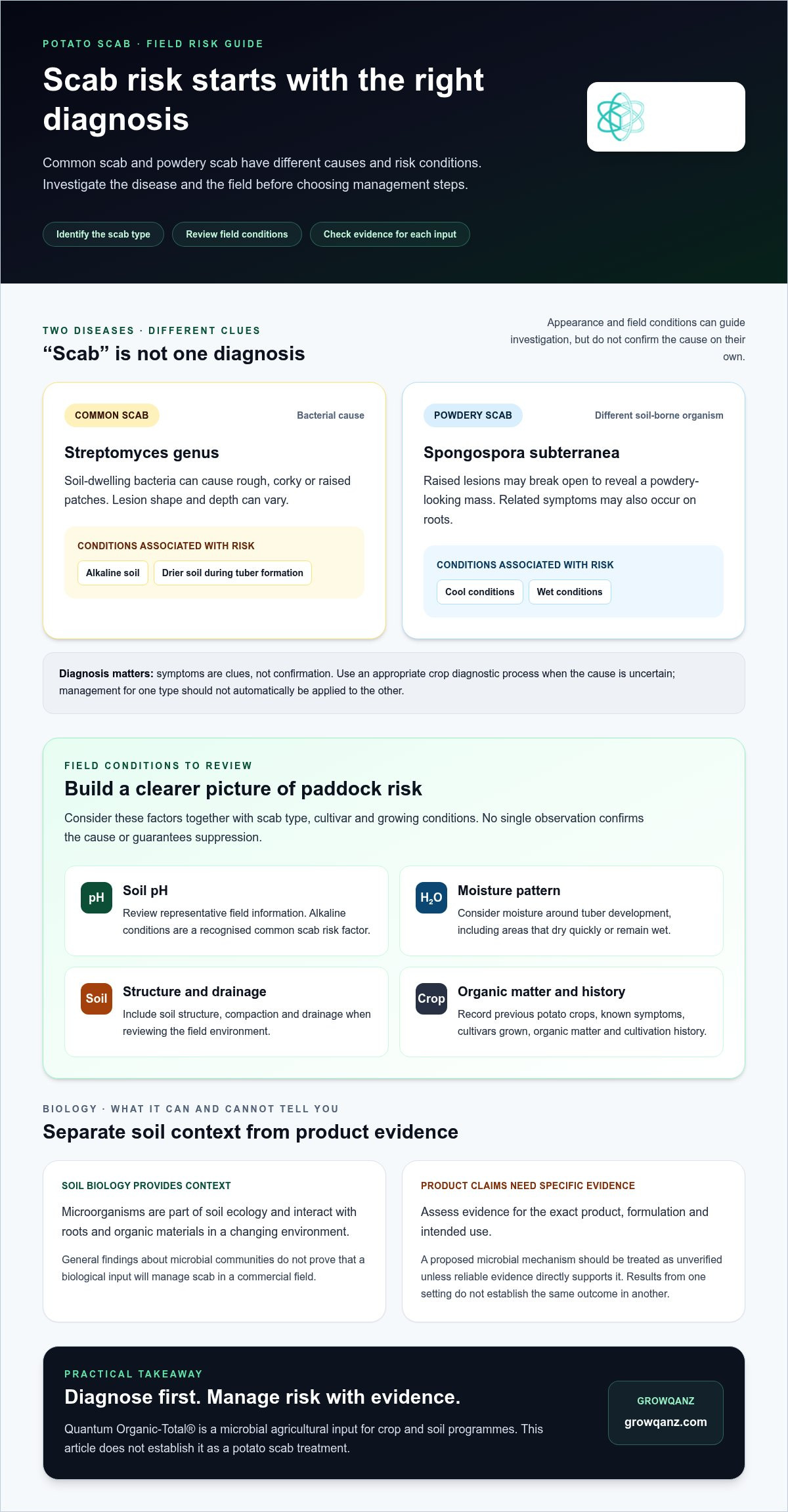
Common scab is caused by soil-dwelling bacteria in the Streptomyces genus. Lesions can appear as rough, corky or raised patches, and their shape and depth can vary. The Common scab overview describes the disease and its association with Streptomyces species. Symptoms are not always distinctive enough to identify the cause by sight alone.
Powdery scab is caused by Spongospora subterranea, a different soil-borne organism. It can produce raised lesions that break open to reveal a powdery-looking mass; related symptoms may also occur on roots. Common scab is often favoured by drier conditions during tuber formation, while powdery scab is associated with cool, wet conditions. These patterns can guide investigation, but they don’t confirm a diagnosis.
When symptoms are uncertain, use an appropriate crop diagnostic process. Distinguishing the diseases matters because their causal organisms and risk factors differ. Management decisions for one shouldn’t automatically be applied to the other.
Why does scab matter to potato growers?
Scab may leave tubers blemished, affecting their appearance and potentially their suitability for a particular grade or market. The commercial impact depends on buyer specifications and the extent and character of the damage, so avoid assuming that every scab-like mark has the same consequence.
Scab symptoms are visible tuber blemishes; a confirmed diagnosis identifies the cause behind those symptoms. This distinction is useful when reviewing affected tubers, paddock history and crop conditions. A diagnosis can narrow the questions to investigate, but it doesn’t by itself establish which field factor contributed to disease.
For growers considering reducing potato scab with soil biology, the first step is to avoid treating “more biology” as a stand-alone answer. Identify the likely disease, then assess the relevant soil and crop conditions. This gives decisions about management practices or biological inputs a clearer basis.
How can soil conditions and biology influence potato scab risk?
Soil is a living system, but biologically active soil isn’t automatically protected from potato scab. Disease risk reflects interactions between the causal organism, the potato plant and conditions around tuber development. Soil pH and moisture are especially relevant to common scab, while organic matter, soil structure and paddock history help describe the wider production context. These relationships can vary with scab type, cultivar and growing conditions.
Which soil factors should growers assess?
For common scab, alkaline soil conditions and dry soil during tuber formation are recognised risk factors. Cornell University’s Potato Scab management guidance discusses how pH, moisture and soil texture relate to infection. Treat these as factors to investigate, not a universal recipe: the relevance of any adjustment depends on diagnosis, the field and the crop programme. Powdery scab has different environmental associations, so advice for common scab shouldn’t be transferred automatically.
Review representative field information on soil pH and consider how moisture has behaved around tuber development. Note areas that dry out quickly or remain wet, and include soil structure, compaction and drainage in the assessment. Organic matter and cultivation history also describe the soil environment and its management; neither alone confirms scab risk or guarantees suppression.
Crop history adds context. Record previous potato crops, known scab symptoms and cultivars grown, alongside soil and seasonal observations. Patterns across paddocks or seasons can help shape questions for diagnosis and management, but they don’t prove a single cause.
What can soil biology tell you, and what can it not?
Microorganisms form part of soil ecology, interacting with roots and organic materials in a changing environment. Research into soil microbes can explain biological processes or investigate particular organisms and conditions. However, a broad finding about microbial communities isn’t proof that a biological input will manage scab in a commercial field.
General knowledge about soil biology explains the living context of crop production; only evidence for a specific product, formulation and use can support a product-performance claim. Treat a proposed microbial mechanism as unverified unless reliable evidence directly supports it. Results for one organism, formulation, cultivar or growing environment don’t establish that the same outcome will occur in another setting.
When reducing potato scab with soil biology, use biological questions alongside diagnosis and field observations, not instead of them. Growers exploring biological inputs can review QANZ soil biology information as part of assessing how an input may fit a broader crop and soil programme.
Which potato scab management options are worth comparing?
No single practice suits every field or scab type. Compare options by their intended purpose, the evidence supporting them and how they fit the crop programme. A biological input isn’t automatically a scab treatment: evidence for a particular organism or biological approach doesn’t prove that a different product will have the same effect.
| Option | Purpose | Evidence to look for | Practical considerations and crop fit |
|---|---|---|---|
| Diagnosis | Clarify whether symptoms are consistent with common scab, powdery scab or another issue. | Assessment of tuber symptoms and, where needed, appropriate diagnostic testing. | Useful before selecting disease-specific actions; symptoms alone may not settle the cause. |
| Crop and soil management | Address relevant field risks through planting choices and management of soil conditions. | Guidance relevant to the scab type, cultivar, soil and growing conditions. | Consider crop history, cultivar, seed health and moisture management together. No one practice is universally effective. |
| Biological-input evaluation | Assess whether an input has a supported role within the wider crop and soil programme. | Evidence for the exact product or formulation, crop, disease, use and trial conditions. | Check its documented intended use and application guidance; don’t assume general microbial research proves scab control. |
How do diagnosis and crop-management practices fit together?
Diagnosis helps direct attention to the factors most relevant to the likely disease. For common scab, soil moisture during tuber development and other soil conditions may warrant investigation; other scab problems can have different risk patterns. Michigan State University’s Common Scab of Potato resource outlines disease-cycle and management considerations. Use such guidance alongside field observations, since cultivar, paddock history and seasonal conditions can affect how a practice fits.
Review planting decisions, the health and source of seed tubers, rotation history and irrigation capability as parts of a combined plan. Rotation or cultivar choice may contribute to management, but neither should be treated as a stand-alone guarantee. Suitability depends on the disease, available cultivar options and production system.
When should a grower consider a biological input?
Consider a biological input only as a potential programme component, not as an established scab treatment by category. Look for evidence that matches the exact formulation and potato use. Note whether findings come from laboratory work, overseas research or field trials under conditions relevant to the crop. For broader context on soil programmes, see microbial solutions for field crops. That information doesn’t, by itself, establish efficacy against potato scab.
How can growers build a practical, evidence-led scab plan?
A useful scab plan links the suspected disease, field conditions and management choices in a clear record. Begin before planting, keep notes during the crop, then compare tuber observations after harvest. This won’t prove that one factor caused scab, but it can reveal patterns to investigate and make future decisions more informed.
- 1. Review past symptoms. Record which blocks had blemished tubers, where symptoms appeared and whether a diagnosis was made. Keep photos and any diagnostic findings with the paddock records.
- 2. Document the next crop. Note the paddock, previous crops, cultivar, seed source and relevant seed-health information. Record available soil-test results, including pH, without treating one result as a complete picture of field risk.
- 3. Track soil and weather observations. Note areas that tend to dry out or remain wet, along with rainfall and irrigation decisions. Record crop timing, especially observations around tuber development, so conditions can be reviewed in context.
- 4. Write down management decisions. Capture planting choices, cultivation and moisture-management actions, including when they occurred and which block they applied to. Make any changes to practice clear in the record.
- 5. Review after harvest. Record tuber symptoms and where they occurred. Compare blocks with similar cultivars or management where possible, while recognising that differences in soil, weather and crop conditions can also affect observations.
What should growers record before planting and during the crop?
Keep records specific enough to be useful next season: a paddock map, crop and cultivar details, seed source, previous scab observations, available soil information, rainfall, irrigation and key crop timings. For example, noting that symptoms occurred in one part of a block is more helpful than recording only that the paddock had scab. Growers in New Zealand should use advice relevant to their location and planting calendar. Seasonal timing and programme recommendations shouldn’t be transferred between regions without considering local conditions.
How should growers review results after harvest?
Compare records and tuber observations across blocks and seasons, but treat any apparent association as a prompt for further assessment, not proof of cause and effect. Note what changed, what stayed consistent and whether the disease was confirmed. This evidence trail can help refine the next crop plan. For broader crop-programme context, see GrowQanz’s vegetable growing programme information.
Reducing potato scab with soil biology is best approached as part of an evidence-led crop plan, rather than as an assumed outcome of adding a biological input. Keep diagnosis, field observations and product-specific evidence central to decisions.
How should growers assess Quantum Organic-Total® for a potato programme?
Quantum Organic-Total® is a microbial agricultural input offered by QANZ for use in crop and soil programmes. Its product category does not establish a role in potato scab management. This article does not establish Quantum Organic-Total® as a potato scab treatment, or claim that it prevents, controls or reduces scab. Any decision to include it should be based on current product information and evidence relevant to the intended crop and use.
What evidence would support considering an input for potato scab?
Look for evidence that clearly identifies what was tested and under what conditions. For a scab-related claim, useful details include:
- the exact product and formulation, not just the microbial-input category
- the potato crop, cultivar and scab type studied
- the trial location, design, treatment and comparison used
- growing conditions and how disease was assessed
- whether evidence came from independent research, manufacturer trials, overseas trials or commercial grower observations
These distinctions matter. Laboratory findings may help investigate a biological process, but they don’t by themselves demonstrate performance in a field crop. Overseas results may not represent New Zealand conditions, and observations from one commercial crop don’t guarantee future outcomes. Evidence for another Quantum formulation must not be treated as evidence for Quantum Organic-Total®.
What should growers check before including it in a programme?
Start with current QANZ technical information for product suitability and application details. Don’t rely on an assumed rate, use or mechanism. Review the information in the context of the diagnosed scab issue, paddock records and wider crop plan. Quantum Organic-Total® product information provides product-specific context, but it shouldn’t be read as proof of potato scab efficacy.
If you operate under an organic certification programme, check current QANZ and BioGro documentation to confirm that the input is suitable for your programme and intended use. Product certification, where applicable, doesn’t make a crop, farm or produce organic; certification decisions depend on the requirements of the grower’s own programme.
When assessing reducing potato scab with soil biology, keep the distinction clear: soil biology is a field of study, while product performance requires evidence for that specific product and use. Include crop details and management records when discussing programme suitability with QANZ.
Make your next potato crop plan evidence-led
Managing scab starts with knowing what you’re dealing with. Common scab and powdery scab have different causes, so tuber symptoms should prompt careful diagnosis rather than an assumption about the disease or its trigger. Paddock history, cultivar, soil observations, weather and crop decisions can then help build a useful record for review after harvest.
Reducing potato scab with soil biology means considering the living soil as part of a broader management plan, not treating general microbial activity as a guaranteed control method. Evaluate biological inputs against evidence for the exact product, formulation and crop use. Quantum Organic-Total® is a microbial agricultural input for crop and soil programmes; this article does not establish it as a potato scab treatment. QANZ supplies Quantum agricultural biological products to growers in New Zealand and Australia.
For product and application support, talk to QANZ about whether Quantum Organic-Total® is appropriate for your crop and soil programme. Careful diagnosis, clear records and measured decisions provide a sound basis for refining your approach season by season.
Frequently Asked Questions
Can soil biology reduce potato scab?
Soil biology may be relevant to scab risk, but general microbial activity isn’t an established control method. Reducing potato scab with soil biology should be considered within an integrated plan based on accurate diagnosis, field conditions and crop management. Research on particular microbes doesn’t establish that every biological input will work against scab. Assess evidence for the specific crop, disease, product and conditions before drawing conclusions.
What causes common scab on potatoes?
Common scab is caused by soil-dwelling bacteria in the Streptomyces genus, including Streptomyces scabies. These bacteria can occur in soil, but their presence alone doesn’t explain whether tubers will develop symptoms. Risk is associated with conditions such as dry soil during tuber formation and soil pH. Investigate these factors alongside crop history, without assuming that blemishes alone identify the cause.
Is powdery scab the same as common scab?
No. Common scab is caused by Streptomyces bacteria, while powdery scab is caused by Spongospora subterranea. Powdery scab can produce raised lesions that break open to reveal a powdery-looking mass, while common scab lesions can be rough, corky or raised. Symptoms may overlap with other problems, so tuber appearance alone may not confirm the disease. Use an appropriate diagnostic process if symptoms are uncertain.
How can I reduce potato scab risk before planting?
Start by reviewing previous tuber symptoms and confirming the likely scab type where possible. Before planting, consider paddock history, cultivar and seed health, along with available soil pH information and the field’s moisture patterns. Crop rotation, cultivar choice and moisture management may form part of a broader plan, but no single practice suits every field or season. Use locally relevant agronomic guidance rather than applying a universal target or treatment.
Can a microbial soil product treat potato scab?
A microbial soil product shouldn’t be assumed to treat potato scab simply because it is described as biological. Look for evidence that identifies the exact formulation, potato crop, disease, treatment and trial conditions. Laboratory research, overseas trials and commercial observations provide different kinds of evidence and may not predict results in a New Zealand crop. Follow current product information and assess any disease-control claim carefully.
Does Quantum Organic-Total® reduce potato scab?
This article doesn’t establish Quantum Organic-Total® as a potato scab treatment, nor does it claim that the product reduces or prevents scab. Quantum Organic-Total® is a microbial agricultural input offered by QANZ for crop and soil programmes. Growers assessing its potential fit should use current QANZ technical information and evidence specific to the product and intended use, rather than extrapolating from other formulations or general microbial research.
Do potato scab recommendations differ between New Zealand and Australia?
Recommendations may depend on local growing conditions, planting seasons, crop programmes and relevant certification requirements. Guidance developed overseas or for another production environment shouldn’t automatically be treated as suitable for New Zealand or Australia. Use information that applies to your country, crop timing and diagnosed scab type, and account for conditions in the individual paddock.
What information should I record when assessing potato scab management?
Record the paddock, previous crops, cultivar, seed source and any earlier scab observations or diagnosis. During the crop, note soil observations, available soil-test results, rainfall, irrigation decisions and crop timing, especially around tuber development. After harvest, record where symptoms appeared and what management choices were made. Comparing these records across blocks and seasons can help identify patterns to investigate, but doesn’t prove that one factor caused the symptoms.
Disclaimer
Important: This article provides general agricultural information only. Product performance can vary according to crop, soil, climate, management practices and application conditions. Trial or research results discussed may have been obtained under specific conditions and should not be interpreted as a guarantee of equivalent results. Always follow current product directions and confirm suitability for your crop, growing system and organic certification requirements. Contact QANZ for current product and application information.
