
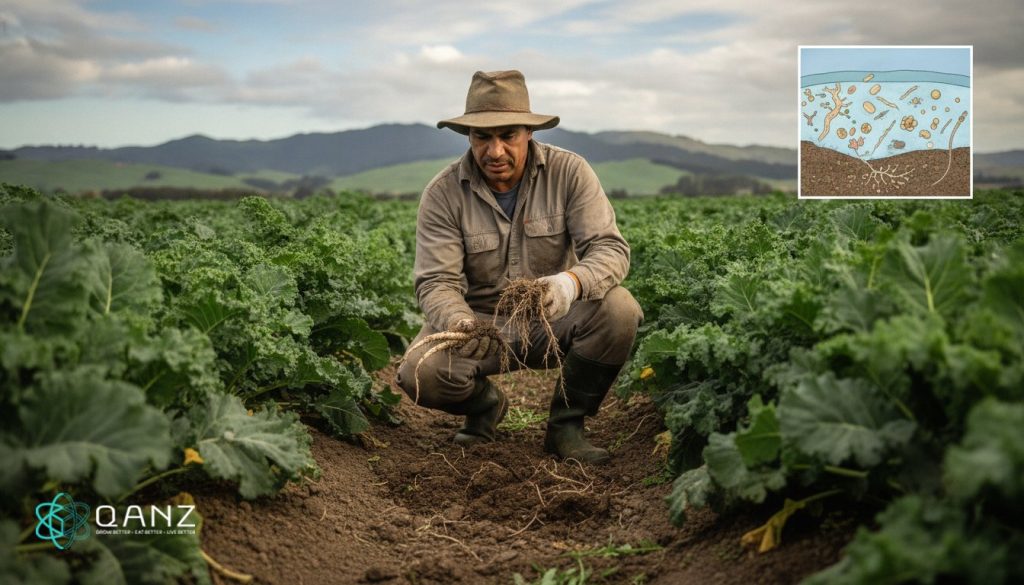
Can intensive vegetable systems maintain high yields without compromising the long-term biological health of the soil? Microbial inoculants for commercial vegetable crops are biological amendments that enhance soil health and plant vitality. These inputs support nutrient cycling and root development, helping crops manage environmental stress. For Australian and New Zealand growers, integrating reliable biologicals like Quantum Organic-Total® into existing programmes can improve soil microbial activity and long-term productivity while meeting strict organic or integrated management requirements.
Many commercial growers across Australia and New Zealand are facing the dual pressure of rising input costs and soil degradation from successive cropping cycles. You’ve likely noticed that traditional chemical regimes often struggle to address climate-driven soil stress or the requirements of modern certification. This guide explores how these biological tools can be strategically integrated into your management plan to restore soil function and support plant resilience. We’ll examine the science of soil microbiology, practical application methods through irrigation, and how to select verified biological inputs that align with professional standards.
Key Takeaways
- Understand how microbial inoculants for commercial vegetable crops function as biological amendments to support natural nutrient cycling and soil structure.
- Learn the critical factors for selecting high-quality inputs, including the importance of BioGro certification for maintaining organic compliance in New Zealand systems.
- Discover practical methods for integrating liquid biologicals into existing management cycles, focusing on optimal soil moisture and temperature for microbial establishment.
- Gain insights into evaluating trial data, distinguishing between local commercial observations and historical overseas evidence to make informed agronomic decisions.
- Explore how specific formulations like Quantum Organic-Total® and Quantum VSC® can be utilised within a structured soil health strategy.
What are microbial inoculants and how do they function in vegetable soils?
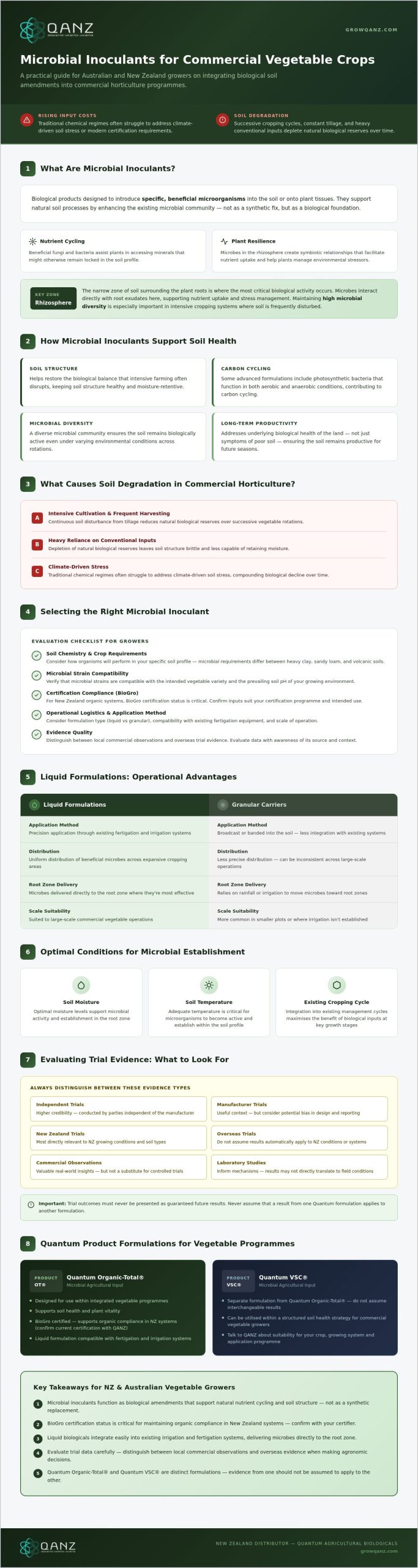
Microbial inoculants are biological products designed to introduce specific, beneficial microorganisms into the soil or onto plant tissues. These inputs aren’t a synthetic fix; instead, they’re intended to support natural soil processes by enhancing the existing microbial community. In the context of microbial inoculants for commercial vegetable crops, these organisms play a fundamental role in nutrient cycling and the maintenance of soil structure. By populating the soil with diverse species, growers can encourage a more resilient growing environment. The broad category of microbial inoculants and biofertilizers includes various fungi and bacteria that assist plants in accessing minerals that might otherwise remain locked in the soil profile.
The role of beneficial soil microorganisms
The most critical biological activity occurs in the rhizosphere, the narrow zone of soil surrounding the plant roots. Here, microbes interact directly with root exudates, creating a symbiotic relationship that facilitates nutrient uptake and helps the plant manage environmental stressors. Maintaining high microbial diversity is particularly important in intensive cropping systems where soil is frequently disturbed. While many products focus on standard soil-borne organisms, some advanced formulations include photosynthetic bacteria. These unique microorganisms can function in both aerobic and anaerobic conditions, contributing to carbon cycling and supporting the wider microbial network. This diversity ensures the soil remains biologically active even under varying environmental conditions.
Addressing soil degradation in commercial horticulture
Intensive cultivation and frequent harvesting can lead to significant soil degradation over time. Constant tillage and heavy reliance on conventional inputs often deplete natural biological reserves, leaving the soil structure brittle and less capable of retaining moisture. This is why biological inputs are becoming essential for modern soil management. They provide a method for replenishing the soil’s living component across successive vegetable rotations. Integrating microbial inoculants for commercial vegetable crops helps to restore the biological balance that intensive farming often disrupts. This approach doesn’t just treat the symptoms of poor soil; it addresses the underlying biological health of the land.
For growers looking to implement these strategies, Quantum Organic-Total® is a microbial agricultural input offered by QANZ. It’s designed for use within integrated vegetable programmes to support soil health and plant vitality. Using these liquid formulations allows for easy application through existing irrigation systems, ensuring the microbes reach the root zone where they’re most effective. By focusing on biological health, commercial producers can build a more stable foundation for their crops, ensuring the soil remains productive for future seasons.
Selecting the right microbial inoculant for vegetable crops
Choosing microbial inoculants for commercial vegetable crops requires a methodical evaluation of soil chemistry, crop requirements, and operational logistics. It’s not enough to select a product based on generic laboratory results; growers must consider how these organisms will perform in their specific soil profile. For instance, the microbial requirements for heavy clay soils may differ significantly from those of sandy loams or volcanic soils. Professional selection involves verifying that the microbial strains are compatible with the intended vegetable variety and the prevailing soil pH. This grounded approach ensures that the biological input supports the plant exactly where it’s needed most.
Liquid microbial soil treatments: Operational advantages
Liquid formulations offer distinct efficiency benefits for large-scale operations compared to traditional granular carriers. Liquid-based organic treatments, such as Quantum Organic-Total®, allow for precision application through existing fertigation and irrigation systems. This method ensures a uniform distribution of beneficial microbes across expansive vegetable blocks, which is often difficult to achieve with solid amendments. Because these liquids are compatible with standard spray equipment, they integrate into established application programmes without requiring capital investment in new machinery. This operational ease is vital for commercial growers who need to maintain strict schedules during the busy planting and growing seasons.
Understanding certification and regulatory compliance
For Australian and New Zealand growers, BioGro certification provides a necessary layer of verification for organic and integrated management systems. It’s essential to distinguish between general biological products and those verified as certified organic inputs. Choosing a product like Quantum Organic-Total®, which is BioGro New Zealand certified, ensures the input aligns with specific organic management plans. Growers should always consult the current QANZ technical and BioGro documentation to confirm specific certification requirements for their region. Using non-certified products can jeopardise organic status, making rigorous verification a critical first step in the selection process. Reliable certification acts as a badge of integrity, giving growers confidence in the purity and safety of their inputs.
Selecting the right biological tool is a balance of science and practical management. You might find it helpful to talk to QANZ about whether Quantum Organic-Total® is appropriate for your specific crop, growing system, and application programme. By aligning your choice with both your soil’s needs and your operational capabilities, you create a foundation for long-term plant vitality and soil health.
Integrating biologicals into commercial vegetable programmes
Successful integration of microbial inoculants for commercial vegetable crops doesn’t require a total overhaul of existing management cycles. Instead, it involves a strategic layering of biological inputs alongside standard operations to support soil function. By using structured Quantum crop application programmes, growers can ensure that microbial delivery aligns with critical growth stages without disrupting the flow of a busy season. Monitoring soil health indicators, such as aggregate stability and organic matter levels, provides a baseline to assess the long-term impact of these programmes. This evidence-based approach allows for adjustments based on the specific biological needs of the field.
Application timing and soil conditions
Microbes are living organisms that require specific environmental parameters to establish and colonise effectively. Soil moisture and temperature are the primary drivers of microbial success; applying biologicals to bone-dry or frozen soil will lead to poor results. In Australian and New Zealand conditions, applying inoculants during the seedling establishment phase is often the most effective strategy. This early intervention helps reduce transplant shock by supporting root development and nutrient access during the plant’s most vulnerable stage. Growers should optimise application rates based on seasonal climate factors, ensuring that the soil environment is conducive to life. Timing applications to coincide with scheduled irrigation events ensures the microbes are moved directly into the rhizosphere where they can begin to function.
Compatibility with other agricultural inputs
Managing the interface between biologicals and conventional fertilisers is essential for maintaining microbial survival. High concentrations of synthetic salts can inhibit microbial activity, so wait periods or specific application sequences are often required for maximum efficacy. Generally, it’s best to separate the application of concentrated fertilisers and biological inputs by several days to allow the soil environment to stabilise. This ensures the introduced microorganisms aren’t overwhelmed by chemical shifts. For those operating within complex integrated systems, professional guidance is often necessary to avoid conflicts between different inputs. You can access bespoke Quantum product and application support to help design a sequence that maximises the survival and performance of your biological tools. This structured approach ensures that soil biology remains a functional asset throughout the entire cropping cycle.
Evaluating evidence: Trials and commercial observations
Professional growers require reliable evidence before integrating new biological tools into their management systems. When evaluating microbial inoculants for commercial vegetable crops, it’s essential to distinguish between independent university trials, manufacturer data, and overseas commercial observations. While laboratory studies provide a controlled look at microbial mechanisms, field performance is influenced by a complex array of environmental variables. A methodical approach to evidence ensures that biological inputs are selected based on their demonstrated function rather than marketing claims. This grounded perspective helps growers build a realistic framework for what biologicals can achieve within their specific soil profiles.
Historical overseas evidence provides a useful starting point for understanding how these products function at scale. For example, a historical trial at Nolt Farm in Pennsylvania, USA, reported a 39% yield increase in a treated area using a programme that included Quantum-Light® and Quantum-VSC®. However, it’s vital to recognise that results from one formulation, such as Quantum-Light®, do not automatically apply to others like Quantum Organic-Total®. Results from individual trials or commercial observations are specific to the formulation, crop, location, treatment and conditions tested and should not be interpreted as a guarantee of equivalent performance elsewhere.
Interpreting overseas trial data for local use
While overseas research demonstrates the potential of microbial technology, Australian and New Zealand growers must account for local agronomic differences. Soil types, climate patterns, and crop varieties in the Northern Hemisphere often differ significantly from those in the Southern Hemisphere. Identifying exactly which formulation was used in a trial is critical; for instance, Quantum-VSC® has a specific role in breaking down organic matter that may be more or less relevant depending on your local soil carbon levels. Growers should view overseas data as a proof of concept rather than a direct blueprint for local application.
The value of commercial grower observations
On-farm observations remain one of the most practical ways to evaluate biological performance. Many professional growers use simple on-farm strips to compare treated and untreated areas, allowing them to observe changes in soil structure and plant resilience firsthand. Rather than focusing solely on short-term yield promises, these observations should prioritise long-term soil vitality and improved nutrient cycling. Monitoring how a crop handles environmental stress after applying microbial inoculants for commercial vegetable crops provides tangible evidence of biological efficacy. This practical, field-based verification allows for the fine-tuning of application rates to suit the unique conditions of your land.
If you’re looking to verify how biological programmes perform in professional settings, talk to QANZ about evaluating biological evidence and trial data relevant to your specific production system.
Quantum solutions for commercial vegetable growers
QANZ provides a focused range of biological solutions designed for the rigorous demands of large-scale horticulture. For those implementing microbial inoculants for commercial vegetable crops, the selection of high-quality, verified inputs is the final step in building a resilient soil system. Quantum Organic-Total® serves as a core microbial agricultural input for both soil and plant applications. This formulation is intended to support natural soil processes by populating the rhizosphere with beneficial organisms. Growers can access technical support for vegetable-specific biological programmes to ensure these inputs are used at the correct rates and timings for their specific region.
Quantum Organic-Total® in practice
The primary use of Quantum Organic-Total® is to enhance the diversity of soil microbial communities within vegetable blocks. It’s a versatile tool that fits into both certified organic systems and conventional transition programmes where reducing synthetic dependency is a priority. For a more holistic approach to soil management, many growers choose to integrate this input with Quantum VSC®. While Organic-Total® focuses on general soil health and plant vitality, Quantum VSC® is a biological product often used within structured programmes to assist with the breakdown of organic matter. This combination allows for a multi-faceted approach to biological soil management that addresses both plant needs and soil structure.
Next steps for professional growers
Moving from theory to field application requires a review of technical data sheets and current certification numbers. It’s essential to check the latest BioGro documentation to ensure the input meets your specific farm and certification requirements. Professional growers should focus on the technical merits of each formulation and how they align with their existing agronomic goals. Organising a consultation can help in designing a customised application programme that accounts for your soil type, irrigation setup, and crop rotation schedule. This ensures the microbial inoculants for commercial vegetable crops you choose are applied with precision. Talk to QANZ about whether Quantum Organic-Total® is appropriate for your crop, growing system and application programme. This collaborative approach ensures that your investment in biologicals delivers the intended support for your land’s long-term productivity.
Strengthening the biological foundation of your vegetable programme
Integrating microbial inoculants for commercial vegetable crops represents a shift toward a more resilient and biologically active soil management strategy. By moving beyond conventional chemistry to support the rhizosphere, you can address the root causes of soil degradation and nutrient inefficiency. These liquid-based organic treatments are designed for ease of use within existing irrigation systems; this ensures that professional growers maintain efficiency without sacrificing ecological integrity.
Success depends on choosing verified, BioGro New Zealand certified inputs that align with your specific management goals. Whether you’re managing a transition programme or maintaining a certified organic operation, the right biological support can enhance long-term plant vitality. QANZ provides dedicated technical support for AU/NZ growers to help navigate these complex biological interactions. Talk to QANZ about whether Quantum Organic-Total® is appropriate for your crop, growing system and application programme. Investing in your soil’s living component is a principled step toward a more stable and productive agricultural future.
Frequently Asked Questions
What are the best microbial inoculants for commercial vegetable farmers?
Selecting the most appropriate microbial inoculants for commercial vegetable crops depends on your specific soil conditions and management goals. QANZ offers Quantum Organic-Total® and Quantum VSC® as liquid-based biological inputs for Australian and New Zealand growers. Rather than looking for a single superlative product, farmers should evaluate formulations based on their intended use, such as supporting soil health or assisting with organic matter breakdown within a structured crop programme.
Can microbial inoculants replace synthetic fertilisers in vegetable production?
Microbial inoculants are intended to support natural soil processes and are not a direct replacement for synthetic fertilisers. These biological inputs enhance nutrient cycling and root-zone interactions, which can improve the efficiency of existing nutrient programmes. In commercial vegetable production, they function as a foundational component of an integrated system, helping to restore soil biological function that may have been depleted by intensive cropping cycles or previous high-input management regimes.
Is Quantum Organic-Total® certified for use on organic farms in New Zealand?
Quantum Organic-Total® is BioGro New Zealand certified as a microbial agricultural input. This certification ensures the product meets specific standards for organic production, though growers should always verify its suitability for their individual organic management plan. It’s essential to check the current QANZ technical and BioGro documentation for your specific farm requirements, as certification status and registration numbers are subject to regular updates. Using a certified input provides professional assurance for those in organic systems.
How do I apply liquid microbial inoculants through an irrigation system?
Liquid microbial inoculants can be applied efficiently through most standard fertigation and irrigation systems. This method ensures even distribution across commercial vegetable blocks and moves the beneficial microorganisms directly into the rhizosphere. Growers should ensure the system is clean and that any concentrated fertiliser salts are flushed before application to maximise microbial survival. It’s often recommended to apply biologicals during the final stage of an irrigation cycle to keep the microbes in the upper soil profile.
What is the difference between Quantum Organic-Total® and Quantum VSC®?
Quantum Organic-Total® is a broad-spectrum microbial input designed for soil and plant applications to support general soil health. In contrast, Quantum VSC® is a biological product often used within structured crop programmes to assist specifically with the breakdown of organic matter and crop residues. While both are liquid-based treatments, they serve different roles in a soil management strategy. Many commercial vegetable growers integrate both formulations to address different biological needs throughout the growing season.
How long does it take to see changes in soil microbial activity?
The timeframe for observing changes in soil microbial activity varies based on soil temperature, moisture levels, and existing organic matter. While some biological interactions begin immediately upon application, tangible improvements in soil structure and nutrient cycling typically develop over several months or successive cropping cycles. Consistent application as part of a long-term biological programme is generally more effective than a single treatment. Professional growers often use soil testing to monitor these biological shifts over multiple seasons.
Do microbial inoculants work in all soil types found in Australia and NZ?
Microbial inoculants can be used across the diverse range of soil types found in Australia and New Zealand, from heavy clays to sandy loams. However, the rate of microbial establishment and the specific biological outcomes are influenced by local soil chemistry and environmental conditions. Factors such as soil pH, compaction, and carbon availability will affect how these microorganisms colonise the root zone. It’s important to consult technical support to tailor an application programme to your specific soil profile.
Can I use microbial inoculants alongside conventional fungicides?
Using microbial inoculants for commercial vegetable crops alongside conventional fungicides requires careful timing to avoid inhibiting the beneficial organisms. Fungicides are designed to target fungi, and some may also impact beneficial bacterial strains introduced through biological inputs. It’s generally recommended to maintain a wait period between fungicide applications and microbial treatments. Growers should consult QANZ technical support for specific compatibility guidance and to design an application sequence that protects the survival of the introduced microbes.
Disclaimer
Important: This article provides general agricultural information only. Product performance can vary according to crop, soil, climate, management practices and application conditions. Trial or research results discussed may have been obtained under specific conditions and should not be interpreted as a guarantee of equivalent results. Always follow current product directions and confirm suitability for your crop, growing system and organic certification requirements. Contact QANZ for current product and application information.
