
The search for Biotanz vs Quantum Organic-Total often leads growers down two very different paths, as one is a biological database and the other is a functional soil input. It’s a common point of confusion for those trying to navigate the complex world of biologicals while managing high-value crops like kiwifruit, potatoes, or viticulture. You need clarity to ensure your soil programme is built on stable, verified science rather than simple trial and error.
We understand that selecting the right microbial input can feel like a gamble when the distinction between information systems and commercial products is unclear. This article evaluates the differences between general biological approaches and the specific microbial consortia of Quantum Organic-Total® to determine the most suitable input for your soil programme. We will examine the importance of shelf stability, the role of BioGro certification, and how to measure the value of a diverse microbial consortium compared to single-strain alternatives. You’ll gain a practical framework to assess biological products and ensure they align with the unique requirements of Australian and New Zealand growing conditions.
Key Takeaways
- Distinguish between biological information databases and commercial microbial inputs when evaluating Biotanz vs Quantum Organic-Total for your specific crop requirements.
- Explore how Quantum Organic-Total® functions as a microbial consortium to support soil health in key regional sectors like kiwifruit, viticulture, and horticulture.
- Identify the critical role of BioGro NZ certification and shelf stability in ensuring the reliability of biological inputs in a professional agricultural setting.
- Learn how to effectively integrate microbial solutions into existing fertiliser and irrigation schedules to maintain a cohesive soil management programme.
- Establish a clear framework for selecting biological inputs based on technical support, application suitability, and verified documentation.
Understanding Microbial Agricultural Inputs in Australia and New Zealand
Microbial agricultural inputs are biological products containing living microorganisms that are applied to soil or plant surfaces to improve nutrient cycling and soil structure. A foundational step for any grower is Understanding Microbial Agricultural Inputs and how they differ from traditional chemical additives. These biologicals represent a shift toward working with natural systems rather than relying solely on synthetic bypasses.
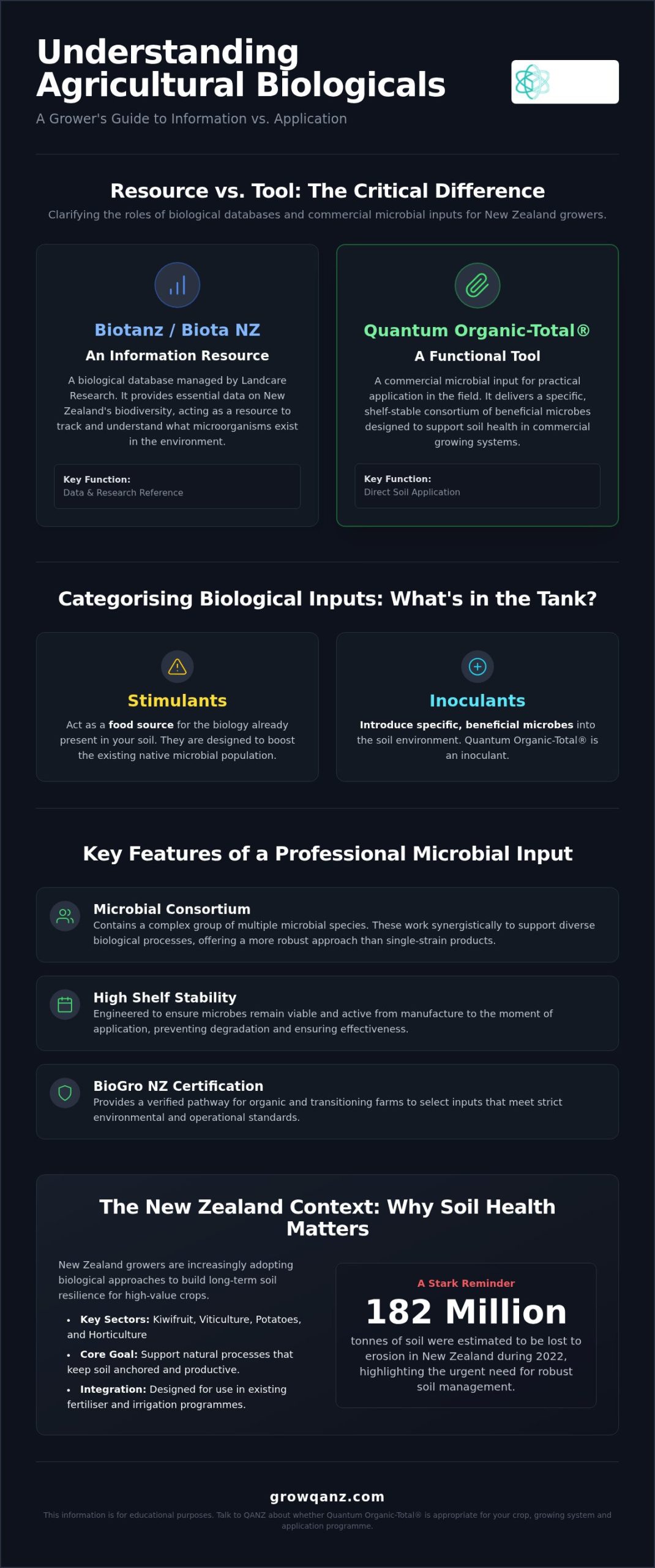
When searching for information on Biotanz vs Quantum Organic-Total, it is vital to distinguish between a resource and a tool. Biotanz, often associated with the Biota NZ database managed by Landcare Research, provides essential data on New Zealand’s biodiversity. In contrast, Quantum Organic-Total® is a commercial microbial input designed for practical application in the field. One tracks what exists in the environment; the other provides a specific consortium of microbes to support soil health in commercial growing systems.
Microbial consortia are defined as complex groups of multiple microbial species that coexist and interact within a single formulation. Unlike single-strain products, these consortia work synergistically to support diverse biological processes in the soil, providing a more robust approach to plant and soil health.
The Shift Toward Biological Soil Management
Growers across Australia and New Zealand are increasingly moving away from purely synthetic programmes in favour of integrated biological approaches. This transition is driven by a need for long-term soil resilience. In 2022, New Zealand lost an estimated 182 million tonnes of soil to erosion, highlighting the urgency of maintaining soil integrity. By focusing on microbial activity, growers of kiwifruit, potatoes, and viticulture can support the natural processes that keep soil anchored and productive. BioGro certification plays a central role here, offering a verified pathway for organic and transitioning farms to select inputs that meet strict environmental standards.
Categorising Biological Inputs: Stimulants vs Inoculants
It is helpful to categorise biological products into stimulants and inoculants to understand their function. Stimulants act as a food source for the biology already present in your paddock. Inoculants, such as Quantum Organic-Total®, introduce specific, beneficial microbes into the environment. This distinction is crucial when choosing a product for a specific soil programme. For a liquid biological input to be effective, it must possess high shelf stability to ensure the microbes remain viable from the point of manufacture to the moment they reach the root zone. Without this stability, the effectiveness of the application can be significantly compromised.
What is Quantum Organic-Total® and How Does it Support Soil Health?
Quantum Organic-Total® is a microbial agricultural input supplied by QANZ, specifically formulated for use within commercial crop and soil programmes. When growers compare the informational nature of Biotanz vs Quantum Organic-Total, they find that the latter is a functional tool designed for direct application to the land. This product provides a specific consortium of live microbes that work within the soil ecosystem to support natural nutrient cycles. The formulation is engineered to be shelf-stable, ensuring that the microbial populations remain active and ready for use without the immediate degradation often associated with liquid biologicals. Detailed technical data and product specifications are available for Quantum Organic-Total® to assist with programme planning.
This input is intended for a wide range of agricultural sectors, including viticulture, horticulture, and broadacre cropping. By introducing a stable population of microorganisms, growers can address the biological component of soil health which is often overlooked in traditional synthetic programmes. It’s a methodical approach to soil management that prioritises long-term ecological balance over temporary fixes.
The Role of Photosynthetic Bacteria
A core component of this microbial consortium is the inclusion of photosynthetic bacteria. In natural soil ecosystems, these microorganisms occupy a unique niche, functioning at the plant-soil interface where they interact with the surrounding environment to support natural biological cycles. Academic interest in this field is growing, as evidenced by the University of Queensland’s engineered microbes research, which investigates how beneficial microbes can enhance soil resilience and plant health. By introducing these specific bacteria through a controlled input, growers aim to support the existing biological infrastructure of their soil.
Certification and Compliance for Growers
For New Zealand growers, BioGro certification is a vital benchmark for quality and regulatory compliance. Quantum Organic-Total® is BioGro NZ certified, providing a level of assurance for those operating within organic frameworks or those looking to transition toward more sustainable practices. Using certified biologicals helps maintain the integrity of organic crop programmes while providing a structured approach to soil health management. It is essential for growers to check the suitability of any input against current BioGro documentation to ensure it aligns with their specific farm management plan and regional requirements. If you are looking to refine your approach, you might consider how to evaluate the role of microbial technology within your specific growing environment.
Biotanz vs Quantum Organic-Total®: Evaluating Biological Approaches
Evaluating the differences in Biotanz vs Quantum Organic-Total requires a clear understanding of how biological information differs from practical application. Biotanz, specifically the Biota NZ database managed by Landcare Research, serves as a comprehensive record of New Zealand’s biodiversity. It is an essential resource for researchers and ecologists tracking flora and fauna. However, for a grower looking to actively manage soil biology, Quantum Organic-Total® provides the physical means to introduce a specific, verified consortium of microbes into a crop programme. One provides the data for identification, while the other provides the tool for soil health management.
| Criteria | Biotanz (Biota NZ) | Quantum Organic-Total® |
|---|---|---|
| Primary Function | Biological database for identification | Microbial agricultural input for soil health |
| Application | Research and data analysis | Direct soil and plant application |
| Stability | N/A (Digital resource) | High (Shelf-stable liquid formulation) |
| Certification | Government/Institutional resource | BioGro NZ Certified |
Choosing a product with verified microbial counts is a fundamental requirement for professional operations. Without transparency regarding the concentration and variety of microbes, growers cannot accurately assess the value of their inputs. QANZ provides technical documentation to support the use of their products, ensuring that the microbial populations remain consistent from the point of manufacture to the moment of application. This level of verification is what separates professional-grade inputs from unverified biological stimulants.
Consistency and Stability in Biologicals
Stability is often the deciding factor for Australian and New Zealand broadacre growers when selecting microbial products. Traditional biologicals, like compost teas, are notoriously variable. Their microbial composition can change rapidly depending on temperature and oxygen levels during the brewing process, which makes them difficult to scale. Quantum Organic-Total® is specifically formulated to be shelf-stable, meaning the microbes remain dormant but viable in the container. This predictability allows for easier logistics and more reliable application schedules across large-scale horticultural and viticultural operations where consistency is paramount.
Evidence-Based Selection for Professional Growers
Independent research and historical data are critical for evaluating any agricultural input. Overseas historical evidence, such as observations from Nolt Farm in Pennsylvania, has shown how specific formulations like Quantum-VSC® and Quantum-Light® perform under specific environmental conditions. It is important to note that these trials were conducted in the Northern Hemisphere and used formulations distinct from those available locally. Identifying the right tool for the job ensures that your investment in soil health is grounded in evidence rather than speculation.
Trial results and observations are provided for informational purposes. Individual outcomes may vary based on environmental conditions, soil types, and management practices. Trial outcomes must never be presented as guaranteed future results.
By prioritising products backed by technical support and verified certifications, growers can reduce the uncertainty often associated with biological soil management. This methodical approach ensures that every input serves a specific purpose within the wider crop management plan.
Integrating Microbial Solutions into Commercial Crop Programmes
Successful integration of biologicals requires a shift in perspective from passive observation to active soil management. When considering the practical application of Biotanz vs Quantum Organic-Total, the focus moves from identifying species in a database to deploying a functional tool in the paddock. Microbial inputs like Quantum Organic-Total® aren’t designed to replace conventional fertiliser programmes. Instead, they act as a complementary layer that supports natural nutrient cycling and soil resilience. For growers in the kiwifruit and viticulture sectors, this means adding a biological component to existing schedules to maintain soil health across multiple seasons without disrupting established management practices.
Integrating biologicals isn’t a matter of simply swapping out one product for another. It’s about enhancing the efficiency of the entire system. Quantum Organic-Total® is intended to work alongside conventional inputs, ensuring that the soil’s biological engine is capable of supporting the crops. This is especially relevant for New Zealand kiwifruit orchards and Australian vineyards, where soil health directly influences the long-term performance of the vines and trees. By aligning biological applications with the specific phenological stages of the crop, growers can ensure the microbes are present when they are most needed.
Application Methods: Fertigation and Foliar Sprays
Liquid microbial inputs offer significant flexibility in commercial operations. Quantum Organic-Total® is compatible with most standard fertigation systems and foliar spray equipment, allowing for seamless integration into current irrigation cycles. This compatibility means growers don’t need specialised machinery to begin a biological programme. Because the formulation is shelf-stable, it handles the rigours of farm storage and application better than unrefined biological stimulants or brewed teas. It’s a practical solution for large-scale horticulture and field crops. Growers should always consult with QANZ technical support to refine application rates and ensure compatibility with other tank-mixed products.
Soil Restoration and Long-Term Vitality
Intensive management practices can sometimes lead to biological imbalances that affect productivity. Microbial solutions are particularly relevant for soil restoration after fumigation, where re-establishing a healthy microbiome is essential for long-term soil structure. Rather than applying products in isolation, QANZ recommends using Quantum biological growing programmes. These provide a structured, evidence-based approach to building soil vitality over time. This methodical strategy ensures that biological inputs work in harmony with the physical and chemical aspects of the soil, providing a stable foundation for future seasons. Talk to QANZ about whether Quantum Organic-Total® is appropriate for your crop, growing system and application programme.
Selecting the Right Biological Input for Your Growing System
Growers must weigh the practical differences between Biotanz vs Quantum Organic-Total when deciding how to invest in their soil’s future. While a biological database provides the necessary scientific context for New Zealand’s biodiversity, a commercial input like Quantum Organic-Total® provides the physical consortium required to support soil health. The selection process should be guided by three primary pillars: BioGro NZ certification, shelf stability, and technical support. These factors ensure that the product you apply is compliant with regulatory standards and remains viable in the field.
Every farm has unique requirements based on soil type, previous land management, and specific crop goals. Professional growers understand that there’s no one-size-fits-all solution in soil microbiology. Instead of chasing vague promises, it’s better to evaluate your specific paddock needs and determine where biologicals can most effectively complement your existing fertiliser and irrigation schedules. QANZ positions itself as a principled partner in this process, providing the expertise needed to integrate microbial technology into a professional agricultural operation.
The Importance of Local Technical Support
Successful biological integration relies heavily on accurate application and product selection. QANZ provides comprehensive support for New Zealand and Australian growers, assisting with the development of tailored application programmes. This isn’t a hands-off process; it involves reviewing technical documentation and understanding how a microbial consortium interacts with your specific environment. It’s important to remember that results are influenced by location, crop variety, and treatment conditions. By working with a local partner, you gain access to insights that are grounded in regional agricultural realities rather than generic overseas marketing.
Next Steps for Professional Growers
If you’re ready to refine your soil programme, the first step is a thorough review of your current inputs and goals. Ensure you have access to the latest BioGro certificates and product specifications to verify compliance. A direct consultation is often the most efficient way to determine which formulation and application rate will suit your specific farm management plan. This methodical approach removes the guesswork and ensures that your soil health strategy is built on a stable, evidence-based foundation. When comparing the data-driven insights of Biotanz vs Quantum Organic-Total, the path forward involves choosing a tool that delivers measurable biological activity to the root zone.
Talk to QANZ about whether Quantum Organic-Total® is appropriate for your crop, growing system and application programme.
Advancing Your Soil Health Strategy with Verified Biologicals
Building a resilient agricultural system requires moving from general data collection to the application of verified, functional tools. Understanding the distinction between Biotanz vs Quantum Organic-Total is a vital first step; it ensures you aren’t confusing a biological database with a professional soil input. By prioritising a shelf-stable liquid formulation that is BioGro New Zealand certified, you gain the predictability needed to manage large-scale horticulture and viticulture operations effectively.
Successful soil management isn’t about replacing proven methods but enhancing them with scientific technical support. Integrating a microbial consortium into your existing programme provides a stable biological foundation for your land’s long-term vitality. We encourage you to evaluate your specific soil needs and crop goals alongside a partner who understands the unique challenges of Australian and New Zealand environments. Every paddock has its own requirements, and a methodical approach ensures your inputs deliver the best possible support for your soil microbiome.
Your commitment to soil health today will support the productivity of your land for many seasons to come.
Frequently Asked Questions
Is Quantum Organic-Total® BioGro certified in New Zealand?
Quantum Organic-Total® is BioGro New Zealand certified as a microbial agricultural input for use in soil and plant applications. This certification provides assurance to growers that the product meets specific standards for natural inputs within the New Zealand regulatory framework. It’s essential to check the current certification status and registration number against official BioGro documentation before incorporating any new input into your farm management plan to ensure it aligns with your requirements.
What is the difference between Quantum Organic-Total® and Quantum VSC®?
Quantum Organic-Total® is a microbial agricultural input designed for use in soil and plant application programmes to support biological health. In contrast, Quantum VSC® is a specific biological product used as a component within wider crop programmes. While both are part of the Quantum family, they have distinct roles in a soil management strategy. Growers should consult technical documentation to determine which product is appropriate for their specific crop type and seasonal application schedule.
Can I use Quantum Organic-Total® with synthetic fertilisers?
You can use Quantum Organic-Total® alongside synthetic fertilisers as it is intended to complement, not replace, conventional inputs. This integrated approach allows growers to maintain their standard nutrient programmes while supporting the biological engine of the soil. When combining these products, it’s important to check for compatibility with other tank-mixed inputs. Talking to QANZ technical support can provide guidance on timing and application methods to ensure the microbial consortium works effectively within your system.
How should I store liquid microbial products to ensure stability?
Liquid microbial products like Quantum Organic-Total® should be stored in a cool, dry environment away from direct sunlight to maintain the viability of the live organisms. The formulation is specifically designed to be shelf-stable, meaning the microbes remain dormant and protected within the container until they are applied. Keeping the product in a stable temperature range ensures that the consortium remains effective for use throughout the growing season across diverse Australian and New Zealand climates.
Does using Quantum Organic-Total® make my farm “certified organic”?
Using Quantum Organic-Total® does not make a farm, crop, or produce “certified organic.” While the product itself is BioGro NZ certified as a natural input, achieving organic status for a commercial operation requires a comprehensive certification process managed by an independent body. This process involves strict adherence to specific standards over several years. This microbial input is a tool that can be used within an organic framework, but it doesn’t confer organic status on the produce.
What is the shelf life of Quantum microbial inputs?
Quantum microbial inputs are engineered as shelf-stable liquid formulations, providing a reliable period of viability when stored according to technical recommendations. This stability is a key feature that distinguishes professional microbial consortia from unrefined biological stimulants or brewed teas, which can degrade rapidly. By ensuring the microbes remain viable in the container, the product offers consistency for growers managing large-scale operations. For specific batch details, growers should refer to the technical information provided by QANZ.
How do I determine the correct application rate for my crop?
The correct application rate is determined by evaluating your specific soil needs, crop goals, and regional conditions. When assessing Biotanz vs Quantum Organic-Total, it’s vital to rely on professional technical support rather than generic recommendations. QANZ provides detailed technical documentation to help you develop a structured application programme for crops like kiwifruit, viticulture, or horticulture. This methodical approach ensures that the microbial consortium is integrated at the right volume and frequency for your specific growing environment.
Are there specific New Zealand trials for Quantum Organic-Total®?
There are no specific New Zealand trial results for Quantum Organic-Total® included in the current approved QANZ evidence. While overseas historical evidence, such as observations from Nolt Farm in Pennsylvania, provides data on formulations like Quantum-VSC®, these results are specific to the Northern Hemisphere and different environmental conditions. Results from individual trials or commercial observations are specific to the formulation, crop, location, treatment and conditions tested and should not be interpreted as a guarantee of equivalent performance elsewhere.
Disclaimer
Important: This article provides general agricultural information only. Product performance can vary according to crop, soil, climate, management practices and application conditions. Trial or research results discussed may have been obtained under specific conditions and should not be interpreted as a guarantee of equivalent results. Always follow current product directions and confirm suitability for your crop, growing system and organic certification requirements. Contact QANZ for current product and application information.
