

To fill the nutrient gap and grow more grass, growers must revitalise soil function through biological nutrient cycling. This process involves using microbial inputs to mineralise organic matter into plant-available forms, unlocking existing soil chemistry. By combining strategic grazing management with BioGro certified microbial treatments, you can improve soil structure and nutrient uptake, leading to consistent pasture growth and enhanced seasonal resilience across your farm.
What if the reason your pasture growth has plateaued isn’t a lack of fertiliser, but a breakdown in the soil’s ability to actually process it? Many New Zealand growers are currently facing a frustrating reality where high input costs aren’t translating into the dry matter production they expect. If you’re wondering how to fill the nutrients gap and grow more grass and get your soils working, the answer often lies beneath the surface in the complex world of soil biology.
It’s exhausting to watch your margins thin while soil compaction and seasonal stress limit your farm’s resilience. This article explains how revitalising soil function through biological nutrient cycling can address these underlying issues. We will explore the mechanics of the nutrient gap, the role of microbial engine rooms, and how integrating products like Quantum Organic-Total® can help get your land working at its natural potential.
Key Takeaways
- Understand the nutrient gap as the discrepancy between applied fertiliser and actual plant uptake, which is often influenced by environmental variables like soil temperature and moisture.
- Discover how to fill the nutrients gap and grow more grass and get your soils working by supporting biological nutrient cycling, where soil microbes mineralise organic matter into plant-available forms.
- Learn how biological inputs complement conventional fertilisers, moving from a reliance on synthetic “hits” to a sustained nutrient cycle that improves soil resilience against seasonal stress.
- Identify practical grazing and moisture management strategies, such as maintaining residuals for regrowth and reducing winter pugging, to preserve soil structure and function.
- Explore how to integrate BioGro certified microbial inputs like Quantum Organic-Total® into your pastoral programme via efficient liquid spray or fertigation systems.
Why Does Grass Growth Stall and What is the Nutrient Gap?
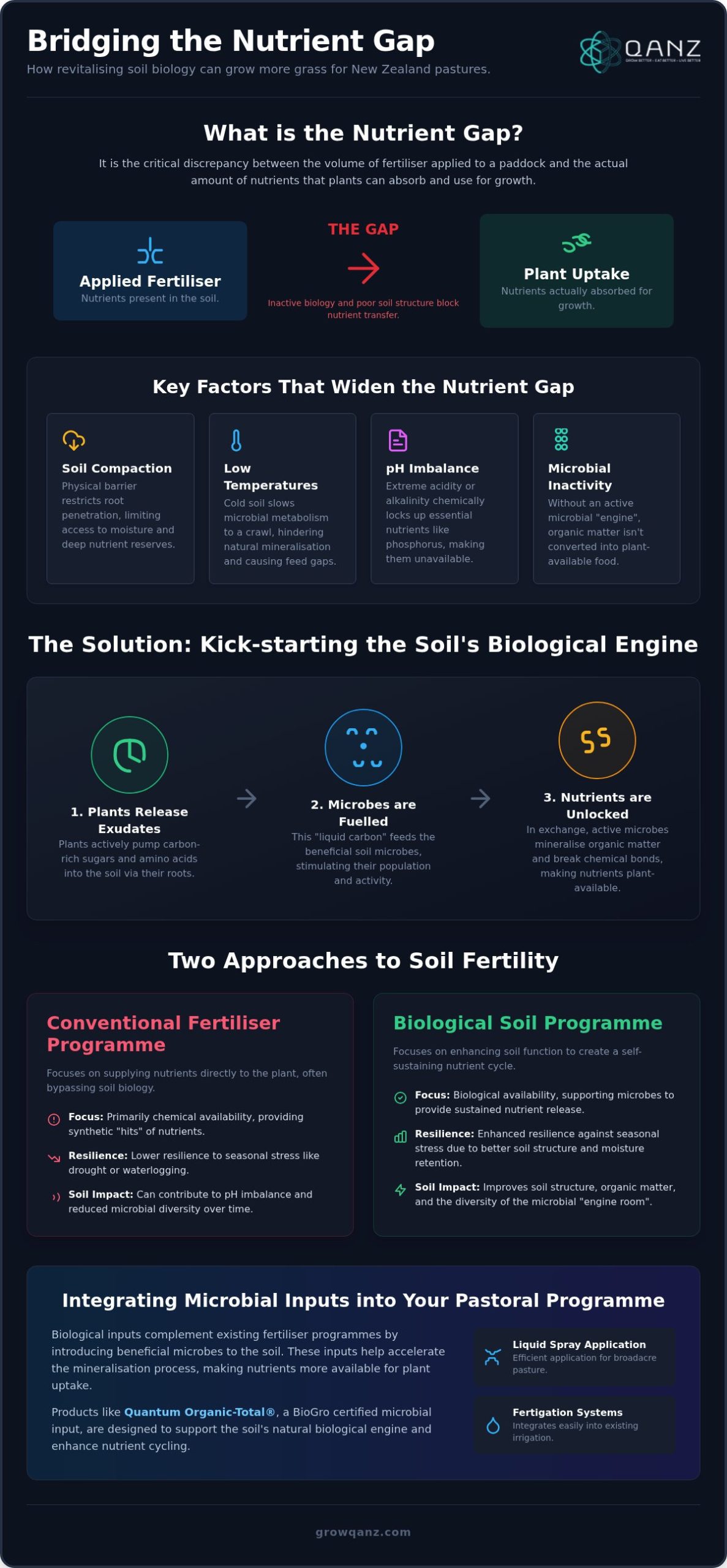
The nutrient gap represents a critical bottleneck for many pastoral operations across Australasia. It’s the measurable discrepancy between the volume of fertiliser applied to a paddock and the actual amount of nutrients that plants successfully absorb. Many pastoralists are looking for ways to improve dry matter production, yet they often overlook how to fill the nutrients gap and grow more grass and get your soils working by addressing biological inactivity. When soil chemistry is present but the biology is dormant, the system is essentially idling; the energy is there, but there’s no mechanism to convert it into motion.
Soil compaction often acts as a physical barrier in this process. When soil is tightly packed, roots can’t penetrate deeper into the profile to access moisture and nutrient reserves. This physical restriction, combined with stagnant microbial activity, ensures that even the most expensive fertiliser programmes can yield diminishing returns. Identifying these barriers is the first step toward revitalising soil function and closing the gap between potential and actual yield.
How Do Soil Temperature and Seasonality Impact Growth?
In New Zealand and Southern Australia, cold temperatures significantly hinder microbial metabolism. When soil temperatures drop, the rate of natural mineralisation slows to a crawl, contributing to the notorious winter feed gap. Traditional fertilisers often show limited efficacy in these conditions because the soil biology isn’t active enough to facilitate the Nutrient Cycling required for plant uptake. Waterlogged soils further exacerbate the issue by creating anaerobic conditions that suppress beneficial aerobic microbes, leaving grass growth stagnant despite nutrient availability.
What is the Difference Between Chemical and Biological Availability?
There’s a fundamental distinction between total soil nutrients and plant-available nutrients. A soil test might show high phosphorus levels, but if the pH is skewed or the soil structure is poor, those elements remain locked in the soil matrix. This lock-up is often a result of chemical bonds that plants can’t break on their own. Factors that widen the nutrient gap include:
- pH Imbalance: Extreme acidity or alkalinity can cause essential elements like phosphorus to bind with iron or aluminium.
- Microbial Inactivity: Without active microbes to break these chemical bonds, nutrients remain inaccessible.
- Organic Matter Breakdown: Stagnant biology fails to convert organic residues into stable humus and available plant food.
By understanding the variables that limit uptake, growers can better identify how to fill the nutrients gap and grow more grass and get your soils working throughout the entire season. Moving beyond a simple chemical approach allows for a more resilient system that responds better to environmental stress.
How Does Biological Nutrient Cycling Restore Soil Function?
While the previous section established that many soils are currently “idling”, biological nutrient cycling is the natural mechanism that shifts the system back into gear. It is the process where soil microbes mineralise organic matter, converting bound elements into plant-available forms. Think of the microbial population as the engine room of your paddock; without these organisms, the fertilisers you apply remain largely static in the soil profile, unable to be converted into the dry matter your livestock require. Supporting this cycle is a fundamental step in learning how to fill the nutrients gap and grow more grass and get your soils working.
Plants aren’t passive observers in this cycle. They actively fuel the soil community by releasing root exudates, which are carbon-rich compounds like sugars and amino acids. In exchange for this liquid carbon, microbes provide the plant with essential minerals and protection. Maintaining soil cover is vital to this process, as bare soil exposes the microbial community to temperature extremes and moisture loss, effectively shutting down the engine room and halting the cycle of growth.
What Role Do Beneficial Microorganisms Play in Nutrient Exchange?
Specific groups of bacteria and fungi are responsible for different stages of residue breakdown. Some specialise in decomposing tough cellulose, while others focus on nutrient cycling within the rhizosphere, the thin layer of soil directly surrounding the roots. A diverse microbial population ensures that nutrient exchange happens efficiently across various environmental conditions, building a resilient soil function that can withstand seasonal fluctuations. You can explore the science behind these processes further by looking into microbial technology and its application in modern pastoral systems.
How Does Biology Improve Soil Structure Naturally?
Microbes do more than just feed the grass; they also build its home. Beneficial bacteria produce sticky substances, often called microbial glues, while fungal hyphae weave through the soil to create stable aggregates. This process improves soil porosity, which is essential for air and water infiltration in typically heavy New Zealand and Australian soils. When soil structure is improved through biological activity, you’ll notice several practical changes:
- Water Movement: Water moves deeper into the profile rather than ponding on the surface or causing winter pugging.
- Root Expansion: Grass roots can penetrate further to access moisture and nutrients during dry spells.
- Aeration: Improved air flow prevents the anaerobic conditions that stall spring growth.
This structural improvement is why grass gets working faster in the spring. It is not just about the temperature; it is about a soil environment that allows the plant to breathe and expand its root system. Supporting these natural processes provides a strategic pathway for how to fill the nutrients gap and grow more grass and get your soils working effectively throughout the season.
Comparing Conventional Fertilisers and Biological Soil Programmes
Understanding the difference between feeding the plant and functioning the soil is essential for long-term productivity. Conventional fertilisers are designed to deliver a rapid “hit” of specific elements directly to the plant. While this can trigger immediate growth spikes, it doesn’t necessarily address the underlying health of the land. In contrast, biological programmes focus on the sustained cycle of nutrient availability. For New Zealand dairy and pastoral farmers, the 190 kg N per hectare cap on synthetic nitrogen application has changed the landscape, making it vital to find ways to do more with less. Integrating biology is a practical strategy for how to fill the nutrients gap and grow more grass and get your soils working within these regulatory limits.
Relying solely on synthetic chemistry can lead to soil degradation over time, as high-salt fertilisers may suppress the very microbes needed for natural mineralisation. Biological inputs are intended to complement, not replace, your existing fertiliser schedule. They act as a bridge, ensuring that the chemistry you apply is actually captured and utilised by the pasture rather than being lost to the environment through leaching or volatilisation. This creates a more stable growth pattern rather than a cycle of “boom and bust” production.
Input Efficiency and Nutrient Uptake
Microbial activity is the primary driver for improving the efficiency of applied fertilisers. When you introduce a microbial agricultural input, you’re essentially boosting the soil’s capacity for nutrient recycling. In a closed-loop pastoral system, microbes break down dung, urine, and plant litter, returning those nutrients to the root zone in a plant-available form. This process reduces the “leakiness” of the system. Without this biological intervention, a significant portion of your investment in conventional inputs may never reach the plant, which only serves to widen the nutrient gap further.
A Balanced Approach to Pasture Management
A successful transition to a biologically-supported system starts with comprehensive soil testing. Identifying specific mineral deficiencies allows you to address chemical imbalances while using products like Quantum Organic-Total® to revitalise the soil’s engine room. It’s important to manage expectations during this process. Biology works at the pace of nature, not with the instant reaction of a chemical growth stimulant. By focusing on long-term soil vitality rather than just short-term spikes, you build a resilient system capable of consistent production. This balanced approach is the most reliable way to understand how to fill the nutrients gap and grow more grass and get your soils working for the long haul.
Practical Strategies to Grow More Grass and Manage Feed Gaps
Practical strategies for better pasture production start with consistent monitoring. A Visual Soil Assessment (VSA) is a reliable field test for evaluating soil structure, porosity, and biological activity. By examining root depth and soil aggregation in the top 200mm of the profile, you can identify precisely how to fill the nutrients gap and grow more grass and get your soils working in specific paddocks. This hands-on approach allows you to adjust management before growth stalls, ensuring your interventions are targeted and effective.
Grazing for Soil Health
Strategic grazing is essential for protecting the soil’s biological engine. Maintaining residuals of approximately 1500 to 1600 kg dry matter per hectare ensures the grass leaf remains an effective solar panel, capturing energy to fuel the root exudates that drive microbial activity. When rotations are managed to allow for a degree of ‘trampling’, livestock help return organic matter to the surface, providing a vital food source for the soil community. Avoiding overgrazing is paramount; stripping the pasture too bare forces the plant to pull energy from its roots, which shuts down the nutrient cycle and leaves the soil vulnerable to compaction and moisture loss.
Seasonal Transitions in AU and NZ
Seasonal transitions in the Southern Hemisphere demand a resilient soil system. In Australia and drier New Zealand regions, biological soil management helps pastures survive the summer dry by improving water holding capacity and structural integrity. Better soil structure, facilitated by microbial glues, allows for deeper water infiltration, which is the primary defence against moisture stress. In wetter areas, the focus shifts to reducing winter pugging. Improved soil porosity allows water to move through the profile rather than ponding on the surface where hooves can destroy the soil structure.
Diverse pasture species, including clovers and deep-rooted herbs like chicory or plantain, support these transitions by providing a varied diet for soil microbes and improving mineral cycling. Transitioning from winter dormancy to a successful spring reset requires a system that can respond quickly to rising temperatures. You can explore pastoral application programmes to see how to integrate these biological principles into your seasonal management. Combining diverse species with strategic grazing is the most effective way to understand how to fill the nutrients gap and grow more grass and get your soils working regardless of seasonal pressure.
Integrating Quantum Organic-Total® into Your Pastoral Programme
Adopting a biological approach requires more than just a change in grazing management; it often necessitates the introduction of specific microbial inputs to jumpstart an idling system. Quantum Organic-Total® is a microbial agricultural input offered by GrowQanz that’s designed to support microbial activity within your existing crop and soil programmes. For growers evaluating how to fill the nutrients gap and grow more grass and get your soils working, this product provides a concentrated consortium of microorganisms intended to revitalise the natural nutrient cycles that have become stagnant. It acts as a biological catalyst, helping to bridge the gap between applied fertiliser and plant uptake by functioning the soil engine room more effectively.
Ease of use is a priority for large-scale pastoral operations. This technology is liquid-based, allowing for efficient application via standard liquid spray equipment or fertigation systems across expansive paddocks. Quantum Organic-Total® holds BioGro New Zealand certification, making it a verified input for sustainable growing programmes and those operating under strict environmental standards. While it’s a powerful tool on its own, Quantum VSC® can also be used in conjunction for specific crop programmes where additional microbial diversity is required to meet production goals.
The GrowQanz Microbial Technology
Quantum Organic-Total® is intended for use in comprehensive crop and soil programmes to support microbial activity. These liquid microbial treatments differ significantly from traditional granular amendments. While granular products often rely on slow chemical breakdown and environmental factors to become active, liquid biologicals deliver microbes directly to the rhizosphere in a form that can begin interacting with the soil community almost immediately. It’s essential to check product suitability and application rates against current GrowQanz technical documentation to ensure the programme aligns with your specific soil type and pasture species. This precision ensures that you aren’t just adding more inputs, but rather adding the right biological components to restore soil function.
Evidence and Observations
Historical overseas evidence provides a technical foundation for understanding how these microbial consortia function in agricultural settings. Observations from Nolt Farm in Pennsylvania, for example, involved the application of Quantum-Light® and Quantum-VSC® to monitor soil and plant responses. We must explicitly label this as overseas historical evidence. It serves as a reference for the technology’s potential but is not a guarantee of equivalent performance in New Zealand or Australian conditions. Local variables such as soil chemistry, climate, and management practices will always influence the final outcome.
Results from individual trials or commercial observations are specific to the formulation, crop, location, treatment and conditions tested and should not be interpreted as a guarantee of equivalent performance elsewhere. Every farm is a unique biological system, and what works in one region may require adjustment in another. If you’re ready to explore how to fill the nutrients gap and grow more grass and get your soils working, talk to GrowQanz about whether Quantum Organic-Total® is appropriate for your crop, growing system and application programme.
Building a Resilient Foundation for Future Growth
Addressing the underlying health of your soil is the most reliable way to secure long-term pastoral productivity. By shifting focus from simple chemical application to active biological function, you move beyond short-term growth spikes toward a system that recycles nutrients efficiently. We’ve explored how strategic grazing and moisture management protect the soil’s engine room, ensuring that your land remains productive even during seasonal transitions. Understanding how to fill the nutrients gap and grow more grass and get your soils working requires a balanced approach where microbial inputs complement your existing fertiliser schedule.
GrowQanz is dedicated to providing technical support for biological growing programmes, supplying growers across Australia and New Zealand with high-quality microbial technology. Using BioGro New Zealand certified Quantum Organic-Total® allows you to support soil biology with confidence, knowing you’re investing in the long-term viability of your farm. If you’re ready to revitalise your soil’s natural cycles and improve pasture resilience, the next step is a professional consultation tailored to your specific needs. Talk to GrowQanz about whether Quantum Organic-Total® is appropriate for your crop, growing system and application programme. Your journey toward a more efficient, biologically active farm starts with a single conversation.
Frequently Asked Questions
How do microbial inputs help fill the nutrient gap in pasture?
Microbial inputs help address the nutrient gap by revitalising the natural biological cycles within the soil. They support the mineralisation of organic matter, which converts bound elements into forms that grass roots can actually absorb. This process is essential for understanding how to fill the nutrients gap and grow more grass and get your soils working by ensuring that applied fertiliser is utilised efficiently rather than remaining static or leaching from the soil profile.
Can I use Quantum Organic-Total® alongside my existing fertiliser programme?
Quantum Organic-Total® is designed to be integrated into your existing fertiliser schedule as a complementary input. It doesn’t replace synthetic fertilisers but rather enhances the soil’s ability to process those nutrients. By improving microbial activity in the rhizosphere, these biological products can help manage input efficiency, which is particularly useful for New Zealand growers working within the 190 kg N per hectare application cap on dairy and pastoral land.
Is Quantum Organic-Total® suitable for certified organic farms in New Zealand?
Quantum Organic-Total® is a BioGro New Zealand certified microbial agricultural input. This certification ensures that the product meets specific standards for sustainable and natural growing systems. However, it’s important to note that using this product does not automatically make a farm or crop “organic.” Growers should always verify their specific requirements against current BioGro documentation and GrowQanz technical information before application to ensure compliance with their certification body.
What is the best time of year to apply biological soil treatments?
Biological soil treatments are typically most effective when applied during periods of active plant growth, such as the spring reset or the autumn flush. These windows provide the soil microbes with the necessary root exudates they need to establish and function. Applying microbial inputs when soil temperatures are rising and moisture levels are adequate ensures the biological engine room can shift into gear more effectively to support consistent pasture production.
Do I need to change my grazing management when using microbial products?
Changing your grazing management isn’t mandatory, but microbial products perform best when supported by strategic grazing practices. Maintaining residuals of approximately 1500 to 1600 kg dry matter per hectare ensures the grass leaf can capture enough solar energy to fuel the root system. This energy is then released into the soil as exudates, which are the primary food source for the beneficial microbes introduced through products like Quantum Organic-Total®.
How long does it take to see changes in soil function after applying biologicals?
Soil biology operates on a natural timeline rather than providing an instant chemical reaction. While liquid-based microbial inputs begin interacting with the rhizosphere shortly after application, measurable changes in soil structure, such as improved aggregation and water infiltration, generally develop over a longer period. Consistent use within a biological growing programme is the most reliable way to understand how to fill the nutrients gap and grow more grass and get your soils working across multiple seasons.
Can Quantum VSC® be used for horticulture as well as pasture?
Quantum VSC® is a versatile biological product that is used in a wide range of crop programmes beyond pastoral grazing. It’s intended for use in horticulture, viticulture, and field crops, including vegetables, fruits, and nuts. GrowQanz provides technical support for integrating Quantum VSC® into various agricultural systems, ensuring that the microbial application is tailored to the specific needs of the crop, the growing system, and the local environmental conditions.
What is the difference between a biostimulant and a microbial inoculant?
A microbial inoculant like Quantum Organic-Total® introduces specific living microorganisms into the soil to support biological function. In contrast, the term biostimulant is often used more broadly to describe substances that may trigger plant growth signals without necessarily containing live microbial consortia. Microbial inoculants focus on functioning the soil’s engine room, helping to build a resilient biological system that supports the natural mineralisation and cycling of nutrients over the long term.
Disclaimer
Important: This article provides general agricultural information only. Product performance can vary according to crop, soil, climate, management practices and application conditions. Trial or research results discussed may have been obtained under specific conditions and should not be interpreted as a guarantee of equivalent results. Always follow current product directions and confirm suitability for your crop, growing system and organic certification requirements. Contact QANZ for current product and application information.
